Sites of Disorder.

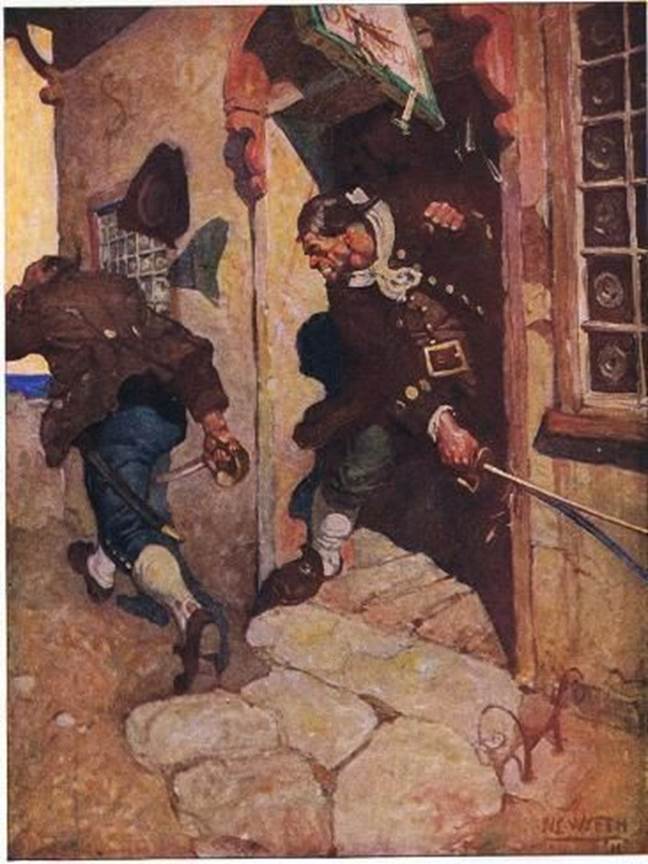
N.C. Wyeth, Gunfight in a Western Saloon, 1916. 

            My Old Man comes home from the war.  Gets a job working in the purchasing department of a Standard Oil office in Seattle.  That palls after a few years, so he quits, goes to Sun Valley, gets work in a resort restaurant, and spends the rest of the time skiing.  Lives cheap and saves money.  When the season ends, he takes the long route back to Seattle.[1]  Probably goes to Las Vegas, Los Angeles, and San Francisco.  He liked to play poker and he was good at it, so places with gambling appealed to him. 

            One time, he’s in San Francisco.  Heard about a game upstairs above a restaurant in Chinatown.  Round-eyes are welcome.  So he goes.  Old building, with authentic versions of all the BS decorations you see in modern Chinatowns.  Wide double doors next to the entrance to the restaurant.  An equally wide wooden staircase leading up to a landing, then the staircase turned right to the “gambling den.”  Landing is decorated with this big ornamental Chinese grill on the wall facing down the first set of stairs to the front doors.  He’s hustling up the stairs, glances to his left at the grill.  There’s a little room behind the grill.  Sitting in a chair looking out is this big Chinese guy.  He’s got a sawed-off double barrel shotgun across his lap.  He’s a Loss Prevention Specialist. 

Kind of reassuring.  Private gambling establishments weren’t legal.  Cops were paid to look the other way, but you couldn’t call the cops if someone ripped you off.  (Same with prostitution and drugs.)  Lots of cash on hand, between the house and the gamblers.  So, if a bunch of guys in overcoats and fedoras came bursting through the front door and hurried up the steps with their hands in their coat pockets, they were liable to catch a double load of double-O.[2] 

Another time he’s in a bar in Seattle, having a drink.  Not a really elegant place, so to speak.[3]  One of the other patrons starts to get quarrelsome.  Bouncer appears, grabs up the guy, and shoves him out of the door.  Tranquility returns.  Later, there’s a knock at the door (that kind of place) and the bouncer goes to open the door.  The previously-discharged patron has returned.  Bouncer slams the door shut, but the guy already has one arm inside the door.  He’s holding a .45-cal. Colt semi-automatic pistol.[4]  He can’t get in—or out, come to that—because the bouncer is putting all his weight against the door.  So he fires off the entire magazine until the slide locks back.  I forget what my old man told me happened next.  Thing is, everybody inside the bar was on the floor from the first instant they saw the gun.  Trying to get behind something solid. 

In any case, “places of ill repute” got that way, in part, because they were attended by “disorder.”  Wyeth is giving us a close-up view of just how bad bad behavior could get. 


[1] Where he picks up work driving a cab and, later, teaching people to drive.

[2] Best I understand it, each 12-gauge shotgun shell loaded with buck shot contains twelve 30-cal. balls.  For a view of the effects, there’s a posthumous photograph of the outlaw Bill Doolin at Doolinbody – Bill Doolin – Wikipedia   

[3] I could have said “if you know what I mean.”  However, even I don’t know what I mean exactly because middle-class people these days don’t have any real idea of what a “dive bar” of the old kind was like.  Well, maybe you do, even if I don’t.  There’s a place down the street, a hole in the wall place.  Sells $3 pints of beer.  However, I heard one co-ed say “After classes this afternoon, I’m going to Milo’s.”  So, not the sort of place that would appear in a Raymond Chandler novel.  And Chandler had drunk in most kinds of places.  Like Joseph Roth. 

[4] Things were all over the place after the war.  Soldiers, especially officers, declared them “lost in battle.”  William Manchester, the writer, threw his into a river during the late Sixties when he grew horrified by senseless violence.  My father-in-law had his from the Navy.  One time his wife wakes him up at night, says “Alec, I think someone is looking in the window.”  He rolls over and reaches under the bed to where he kept the gun.  Fired a shot through the window, then went back to sleep.  Defense Department sold off tons of them as “War Surplus.”  Same for the M-1 carbine.  Gun dealers advertised it as a “light sporting rifle.”  Somebody, nobody knows for sure who, shot Ben Siegel in Hollywood.  Bunch of times.  With a guy like that, you’d want to be sure.  Then there were the Lugers. 

The imagination of little boys 2.

A person in a garment holding a telescope

AI-generated content may be incorrect.Billy Bones, retired pirate captain.  Not in very comfortable circumstances by the look of it: rum scars on his nose; raggedly sewn-up scar on his right cheek (probably didn’t do that shaving); right sleeve of his coat is burst at the shoulder and out at the elbow; wrapped up in an old boat-cloak.  He awaits the retribution for his acts and it isn’t coming from the Crown Prosecution Service either.  He’s standing on a cliff where he can watch the sea, he’s got his brass spy-glass, and the scabbard of his cutlass is visible.  Still, there’s much determination and no fear in that face. 
Lesson: A century before, a Royalist historian described Oliver Cromwell as “that brave, bad man.”  One thing that makes History so much fun to read and so awful to live through is that there’s a bunch of these people in any given population.  “Fight! Fight! Fight!” as someone said.   

All sizes | Captain Bill Bones by N. C. Wyeth. “Treasure Island” by Robert Louis Stevenson. NY: Charles Scribner’s Sons, 1911. | Flickr – Photo Sharing!    

Billy Bones has been “tipped the black spot” in the tavern of the “Admiral Benbow Inn,” home to young Jim Hawkins and his widowed mother.  The guy running away had tracked down Billy Bones and given him a piece of paper with a spot of black ink on it.  In the many days ago, it meant a death sentence.  Billy replied in more immediate terms.   Giclee Print: Captain Bones Routs Black Dog: One Last Tremulous Cut Would Have Split Him Had it Not Been Intercep by Newell Convers Wyeth : 12x9in 

Lesson:

“Old Blind Pew.”  Retribution in human form.  Got whacked on the head by a falling yard arm in a fight at sea or caught a load of gravel in the face pushed up by ricocheting round-shot in a fight ashore.  (The latter is what took off young Horatio Nelson’s arm.)  Now with a black silk scarf around his head to cover his ruined eyes; tap, tap, tapping along the road.  He’s been abandoned by his fellow evil doers before the posse can arrive.  3:10 to Yuma (2007) – I hate posses 

            After the quarrel in the tavern, Billy had a stroke and died.  Awkwardly, he had not paid his bill.[1]  Anyway, Jim’s mother is determined to collect what is owed her, in spite of the danger that the pirates will return to kill Billy Bones.  So, they open his sea chest.  There’s money, but most of it isn’t British and Mrs. Hawkins, worthy soul though she is, isn’t a foreign exchange trader.  Eventually—it’s getting dark and Jim is offering wise counsel—she settles for grabbing an oil-skin-wrapped packet.  They bolt out one door while the pirates approach another door. 

Lesson: “There’s no honor among thieves.” 

In the background stands “The Admiral Benbow Inn.”

All sizes | Old Pew by N. C. Wyeth. “Treasure Island” by Robert Louis Stevenson. NY: Charles Scribner’s Sons, 1911. | Flickr – Photo Sharing! 

            The oil-skin packet turns out to contain a treasure map.  A bunch of the respectable local notables are consulted; they see a chance to become “rich as Nazis”—as Mr. Burns once put it; and they throw in together.  They hire ship and a captain, get a crew; take Jim along because it’s his map; and set sail for wealth and adventure.[2] 

Jim Hawkins leaves home.  He’s dressed in plain brown clothes; he has his few possessions tied up in a red and white polka dot bandana that is tied to a stick.  His mother has already lost her husband and now her son is departing.  She lifts her apron to her face.  Young Jim looks neither excited nor regretful.  I see determination.  He’s already turned his back on the inn and on his mother and on his past.  He’s now looking toward the road that will take him away.[3] 

            Then, there was a long-held belief that the inner person was expressed in the outer form.  The great Soviet movie director Serge Eisenstein believed this.  It guided all his casting decisions.  (Look at the officers on the “Battleship Potemkin.”  Battleship Potemkin (1925) – Meat Scene – High Quality – With English Subtitle ) Compare Jim’s face with that of Billy Bones or Pew.  The faces of the pirates are less-than-human/animalistic; full of strength, anger, and ruthlessness. 

Jim Hawkins Leaves Home by N. C. Wyeth. “Treasure Island” … | Flickr 

In the galley of the ship.  The hired captain had hired a crew.  One was the sea-cook, called “Long John Silver.”  “Long” means he was tall.  He’s got only one leg.  “Oh, poor man!  In such a heartless time in History!”  Well, not exactly.  “Right man-o-wars-men” (hands in the Royal Navy) who lost a leg in battle couldn’t go climbing up the rigging anymore.  So, they often got trained as cooks.  All Silver’s one-leg means is that he got badly wounded in a sea-fight.

There was an old saying that experienced sailors (“Old Salts”) joined a new ship carrying “bag, box, and bird-cage.”  Generally exotic birds they had picked up on some voyage to a distant, foreign land.[4] 

Sailors also had many of really interesting stories to tell.  Some of which may have been true.  (Read a few pages of Camoens, “O Lusiads” some time.)  Jim found Silver to be fascinating and likeable.  Spent a lot of time in the galley. 

Long John Silver and Hawkins by N. C. Wyeth. “Treasure Isl… | Flickr 

Lesson: Your “own kind” aren’t the only people worth knowing. 

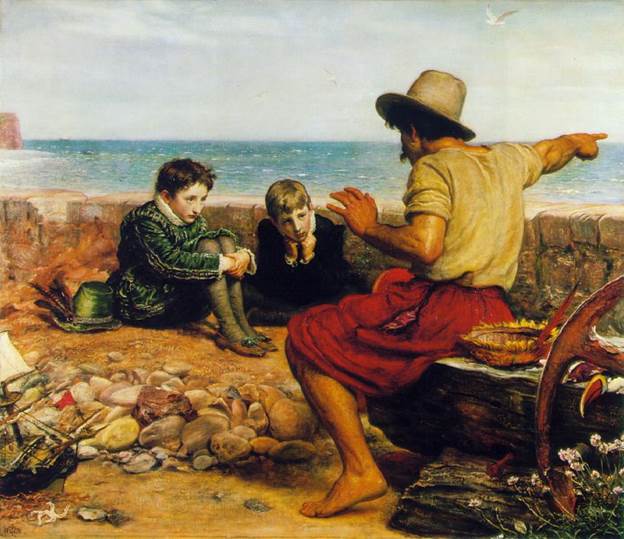
Young Francis Drake listening to an old sailor’s stories down in the West Country. 

Sir Francis Drake – Uncyclopedia 

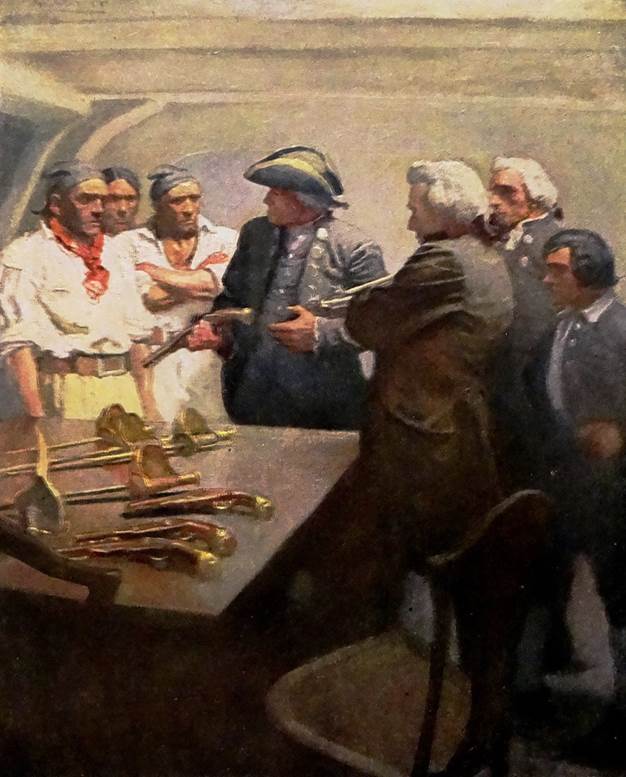
Most misfortunately, Silver is one of the pirates who had been hunting Billy Bones.  Bones, in turn, had been their one-time captain.  So are most other members of the crew.  Their plan is discovered accidentally by Jim.  They’re going to seize the ship, get the map, and go for the treasure out of which Billy Bones had cheated them.  Jim narks on the plot, and the bougie treasure-hunters prepare to defend themselves from the prole treasure-hunters.

Lesson: Well, maybe sticking with your own kind is best after all. 

All sizes | Preparing for the Mutiny by N. C. Wyeth. “Treasure Island” by Robert Louis Stevenson. NY: Charles Scribner’s Sons, 1911. | Flickr – Photo Sharing! 

Anyway, the story proceeds from there.  If you know it, I don’t need to say more.  If you don’t know it, then I don’t want to spoil the rest of it for you. 

By way of Envoi: John Oxenham in a Devon tavern. 


[1] That’s why hotels always get your credit card number as part of the reservation process.  What if you’re sitting in the breakfast room in a hotel in Salt Lake City working through as big a plate of waffles, scrambled eggs, link sausages, tiny blueberry muffins—all of it covered in hot sauce, and several cups of coffee.  Then some villainous-looking guy barges in wearing a MAGA hat and a “SL  UT” tee-shirt?  Starts heaping abuse on you about something, so you trying shoving his head into the waffle iron, then he runs away.  So you go back to your room, but all the stuff you ate at breakfast is clogging the arteries, and you die right there.  Big problem for the hotel, especially since the maids aren’t going to come around to put out clean, threadbare towels and slivers of soap until after you check out in a couple of days.  What to do? 

[2] This was before the government would stick in its oar and claim a share.  You think I’m kidding?  Look at the history of state lotteries.  Horning in on the old numbers racket, then paying winners about two-thirds of what bookies used to pay. 

[3] “’Til Bill Doolin met Bill Dalton//He was workin’ cheap, just bidin’ time//Then he laughed and said,”I’m goin,”//
And so he left that peaceful life behind.”—Glenn Frey, Jackson Brown, Don Henley, J.D. Souther.  What a team. 

[4] Which is better than trying to keep a pet alligator on a ship.  What if they get loose and make it to the bilge?  Live off of rats for a while, get bigger, and start smelling the salt-horse in the food casks?  Makes it risky for crewmen trying to heave up the rations out of the hold.  Or bet on rat-fights in the cable tier, contrary to good order and discipline. 

Sleigh Ride.

            Imagine a Russian four-horse sleigh.  Coming home from a Christmas party at a nobleman’s country estate, it is loaded with presents.  Its passengers are bundled in furs and further insulated against the cold by much wine and an elaborate meal.  Sleep beckons. 

            Glancing drowsily toward the nearby forest, one among them sees the glitter of eyes watching from the woods.  “Wolves,” he says.  The sleigh-driver urges his horses on a bit.  Looking back, the passengers see a pack of wolves emerge from among the trees.  Then the leader of the pack begins to run after the sleigh.  The others follow.  Looking back, the driver sees them and quickly cracks his whip.  The horses surge forward and the passengers come fully awake.  Safety lies only in reaching their own country house. 

            The wolf-pack gains ground.  The driver belabors his horses with the whip, but calls to his passengers that they must throw things overboard.  That will lighten the load for the horses and it may distract the wolves.  Hampers filled with left-overs are the first to go.  The wolves pause briefly to snap at the offerings, but then come on with appetites whetted.  Gifts still wrapped in paper and ribbon go over the back next.  The wolves hardly glance at these, just keep rushing toward the sleigh.  Panic begins to grip the people on the sleigh.  Would they reach home before the wolves caught up? 

            So it was with rearmament in the Thirties.  Germany was the leader of the pack, Japan and Italy were other members of the pack; Britain and France were the passengers in the sleigh; and rearmament itself was the sleigh. 

            For more detail and depth on these issues, you can see additional posts on this blog. 

            The Costs of the First World War.  The Costs of the First World War. | waroftheworldblog 

            Appeasement and Beliefs.  Appeasement and Beliefs. | waroftheworldblog 

            Britain, Appeasement, and Today.  Britain, Appeasement, and Today. | waroftheworldblog 

            France and Appeasement in the Thirties. France and Appeasement in the Thirties. | waroftheworldblog   

            Crossing the Line.  Crossing the Line. | waroftheworldblog 

            Hitler’s War.  Hitler’s War. | waroftheworldblog 

            Why write this stuff NOW?  Why write?  I’m a historian trying to make sense of human actions under the pressure of ideas and events.  It’s my way of trying to serve a useful purpose beyond my own enjoyment.  Why NOW?  I suspect that those times inform our times.  China is the leader of the pack; Russia, North Korea, and Iran are the other wolves.  Maybe I’m just crying “Wolf!” 

British Disarmament in the Nineteen Twenties.

            Britain’s military spending had soared during the First World War.  It remained high in the immediate aftermath of the war: £766 million in 1919–20.  Then, in August 1919, led by the Secretary of State for War and Air,[1] the Cabinet’s Committee of Imperial Defence adopted the “Ten Year Rule”: the government would base its defense budgets “on the assumption that the British Empire would not be engaged in any great war during the next ten years.” 

            From January 1920 to July 1921, Britain suffered a severe recession.  In 1921, the media titan Lord Rothermere founded the “Anti-Waste League” to pressure the government.[2]  It worked: the government appointed a budget-cutting Committee on National Expenditure with Sir Eric Geddes as chairman.  What followed became known as the “Geddes Axe.”[3]  In the end, total defense spending fell from £189.5 million (1921–22) to £111 million (1922–23), before rebounding to £114.7 million in 1924–25.[4] 

            Then a series of international agreements altered the context.  The Washington Naval Conference (1921-22) prevented a naval arms race between Britain, the United States, and Japan.  The Dawes Plan (1924) conceded to German objections on reparations.  The Locarno Pact (1925) stabilized relations in Western Europe between Germany and its former opponents.  In 1925, the new—and very popular in Britain–League of Nations began pushing for a World Disarmament Conference that would reduce “offensive” weapons almost out of existence.  The Versailles treaty had substantially disarmed Germany; now it was time for the other powers to follow suit.  A reduced chance of war would justify deep cuts in military budgets.  In 1928, in light of all these developments, the Chancellor of the Exchequer[5] persuaded the Cabinet to make the “Ten Year Rule” permanent unless specifically changed by the government.   

In the early Thirties, the Great Depression forced still more economies: defense spending fell to £102 million in 1932.  In April 1931, the First Sea Lord told the Committee of Imperial Defense that “owing to the operation of the ‘ten-year-decision’ and the clamant need for economy, our absolute [naval] strength also has … been so diminished as to render the fleet incapable, in the event of war, of efficiently affording protection to our trade.”  Moreover, if the Navy had to move the bulk of its strength to the Far East to deal with Japan, it would have the means to defend neither Britain’s overseas trade nor Britain itself. 

            In September 1931, Japan seized the Chinese outlying province of Manchuria.  On 23 March 1932, the Cabinet formally abandoned the “Ten Year Rule.”  However, it stipulated that “this [change] must not be taken to justify an expanding expenditure by the Defence Services without regard to the very serious financial and economic situation” of Britain. 

Then, in January 1933, Adolf Hitler came to power in Germany.  War was less than seven years, not ten, away.  Much rearmament would have to be done in great haste. 


[1] Winston Churchill. 

[2] See: Anti-Waste League – Wikipedia and Harold Harmsworth, 1st Viscount Rothermere – Wikipedia  Comic in light of current events.  However, it was his rival, Lord Beaverbrook, who was the immigrant. 

[3] On Geddes, see: Eric Geddes – Wikipedia   On the Committee on National Expenditure, see: Geddes Axe – Wikipedia 

[4] For its part, social spending (education, health, housing, pensions, unemployment) fell from £205.8 million (1920–21) to £182.1 million (1922–23) to £175.5 million (1923–24), before rising to £177.4 million (1924–25). 

[5] Winston Churchill. 

Movies About War at Sea: Bear With Me Here.

            C.S. Forester (1899-1966)[1] was rejected when he volunteered for military service during the First World War.[2]  He tried med school, but left without the MD.  He tried writing.  This time he got what he wanted.  Forester discovered “write fast, send it off, and start something new—you’ll learn as you go.”  In 1922 he started a relationship with Methuen publishers that led to four popular history books.[3]  In 1924, he published two little noticed novels; in 1926 he hit pay-dirt with Payment Deferred; in 1927 he wrote two more little-noticed novels, and a third in 1928; in 1929 he hit pay-dirt again with Brown on Resolution; in 1930 and 1931 he wrote two more little-noticed novels; then in 1932 and 1933 he wrote two successful historical novels, Death to the French,[4] and The Gun.[5]  Then, suddenly, he was successful.  He got a contract to spend a quarter of each year in Hollywood working on screen-plays.  In 1935, “Brown on Resolution” became a movie[6]; he published both the still highly-regarded The General and The African Queen (and the soon-forgotten The Pursued).   In 1937 and 1938 he published the first three novels in the “Horatio Hornblower” series.[7]  These books launched a string of a dozen works that dominated his later career.  Not knowing this in advance, in 1940 he wrote To the Indies, about Spanish conquistadors. 

            Then the Second World War came.  He had missed “doing his bit” in the first war; he wasn’t going to miss it this time.  He couldn’t soldier, but he could write.  By 1938, he had created a series of British characters who were stolid, courageous, undeterred by adversity, and inventive about overcoming it.  He had mastered the action scene.[8]  The British Ministry of Information sent him to America.  “You’ve been there, you know them, make us sympathetic, eh what?”[9] 

            So he moved to the United States.  Lippity-lippity quick like a bunny, he wrote another novel about war in the Age of Fighting Sail.  This time, the Hero-Captain was an American during the War of 1812.[10]  It turns into a story of Anglo-American friendship developing in wartime.  Timely, huh?  Appearing in Summer 1941, it was a huge hit with critics and readers.  He wrote a magazine story about Americans flying in the RAF while the United States remained neutral.  It got made into a successful movie.[11]  He wrote a magazine story about Commando raids on occupied Europe.  It got made into a movie.[12]  In 1942-1943, the Royal Navy took him along on missions.  A trip on H.M.S. Penelope during a convoy to Malta resulted in the trim little fact-based novel The Ship (1943).[13] 

            After the war he stayed in America.  He continued the Hornblower series to completion.[14]  He also wrote a bunch of other stuff.  In part, he wrote a different kind of fiction.  The Sky and the Forest (1948) seems to me like the inspiration for Chinua Achebe, Things Fall Apart (1958).  Or perhaps Achebe just reacted against the White man’s view of Africa, like he did with Joseph Conrad and Joyce Cary.  But that’s just me.  Randall and the River of Time (1951) is a bit of a head-scratcher, but it seems to me a riff on Ecclesiastes 9: 11-12.  In part, the cobbler returned to his last, writing The Naval War of 1812/The Age of Fighting Sail (1957) about the naval side of the War of 1812; and Hunting the Bismarck/The Last Nine Days of the Bismarck/Sink the Bismarck (1959).[15] 

Among that “other stuff” is The Good Shephard (1955).  The book brings together The Captain from Connecticut and The Ship.  That is, it is the story of an American Captain commanding the escort vessels of a convoy crossing the Atlantic in the face of ferocious U-boat attacks early in 1942.  From this novel came the movie “Greyhound.” 


[1] I think that I had read all his “Hornblower” books by the time he died.  I was then twelve years old. 

[2] Only a serious medical problem would get you rejected by the British Army in 1917-1918. 

[3] Victor Emmanuel II (1922); Napoleon and His Court (1922); Josephine, Napoleon’s Empress (1925); Victor Emmanuel II and the Union of Italy (1927); Louis XIV, King of France and Navarre (1928). 

[4] OK, this has a funny side to it.  In America, it was titled Rifleman Dodd and its central character is Rifleman Matthew Dodd.  He is a soldier in the 95th Regiment of Foot who becomes separated from his unit during Sir Arthur Wellesley’s retreat to the Lines of Torres Vedras.  There is also a Rifleman Matthew Dodd who becomes separated from his unit in the 95th Regiment of Foot during Sir John Moore’s retreat to Coruna.  He appears in Bernard Cornwell, Sharpe’s Escape (2004).  Not an accident. 

[5] Very loosely adapted as “The Pride and the Passion” (dir. Stanley Kramer, 1957).  Interesting back-story. 

[6] Forever England 1935 John Mills (youtube.com).  Later remade as “Sailor of the King” (dir. Roy Boulting, 1953)  Sailor Of The King 1953 (youtube.com) 

[7] The Happy Return/Beat to Quarters (1937); A Ship of the Line and Flying Colours (both 1938).  Warner Brothers bought all three.  “Captain Horatio Hornblower” (dir. Raoul Walsh, 1951) tried to squeeze all three into one movie.   

[8] Of course the battles are well done, but the towing-off of the dismasted flagship in Ship of the Line is memorable. 

[9] Lynne Olson, Those Angry Days: Roosevelt, Lindbergh, and America’s Fight Over World War II, 1939-1941 (2013) casts some light on the British information/influence operations. 

[10] Captain from Connecticut (1941). 

[11] “Eagle Squadron,” (dir. Arthur Lubin, 1942). 

[12] “Commandos Strike at Dawn” (dir. John Farrow, 1942).  Filmed on Vancouver Island because of the close resemblance to Norway.  HA! 

[13] On the background and significance for this convoy, see My Weekly Reader 14 June 2021. | waroftheworldblog 

[14] Commodore Hornblower (1945); Lord Hornblower (1946); Mr. Midshipman Hornblower (1950); Lieutenant Hornblower (1952); Hornblower and the Atropos (1953); Hornblower and the Hotspur (1962).  

[15] See: “Sink the Bismarck!” (dir. Lewis Gilbert, 1960).  Sink the Bismarck! 1960 Film in English Full HD, Kenneth More, Dana Wynter, Carl Möhner (youtube.com)  Gilbert seems unknown now, but he directed a bunch of interesting stuff.  Started with a short documentary on how cod liver oil is made.  Lesson for all young people there.  That same year, the country-western singer Johnny Horton came out with a song “Sink the Bismark!” (1960).  American theaters often ran the song as part of the trailer for the movie. Sink The Bismarck (youtube.com)