Staircase or Slide?

            Mandy Rice-Davies, a secondary figure in the “Profumo scandal,” later described her life as “one slow descent into respectability.”[1]  That’s pretty much the conventional view of aging.  More than a decade ago, one student of epigenetics[2] argued that aging became linear after puberty.[3]  Or, as a friend once remarked, “Once an adult and twice a child.” 

            Modern Science is beginning to have doubts.  In place of a slow descent along a glide path leading to your children abandoning you in your wheel-chair at the dog track, it has been suggested that aging happens in more-or-less predictable “bursts.”[4]  One study[5] analyzed molecular changes from blood samples.  What the researchers discovered was that at around age 44 bodies experienced molecular changes in muscle function and the metabolization of fat and alcohol.  At around age 60, more changes occurred in muscle function and in immune dysfunction.[6]  It is posited that the changes may explain why people have more trouble processing alcohol after age 40 and why they become more vulnerable to illnesses after age 60.

            Of course, poor life-style choices around diet and exercise appear to play a large role in progressive ill-health.[7]  Do the poor choices produce the metabolic changes?  Well, studies of mice found “sudden chemical modifications to DNA” happened in early-to-mid life and again in mid-to-late life.  Probably not a huge share of obese, alcoholic mice.[8]  Similarly, a study of blood plasma from 4,000 participants showed spikes of proteins linked to aging in the fourth, seventh, and eighth decades of life. 

            So far, researchers haven’t discovered any major ways to countering or controlling aging.  That would be to ask too much of Science at this early stage.  Are there significant differences between individual humans?  Are there significant differences between men and women?  Can anything significant be done to slow aging?  More work needs to be done. 

            Then there’s the $64 question: can anything be done to understand and control cognitive decline?  Who wants to be some “fine figure of a man” with his feeding instructions tattooed on his forehead for the convenience of the para-professionals? 


[1] On Rice-Davies, see: Mandy Rice-Davies – Wikipedia; on the “Profumo affair,” see: Profumo affair – Wikipedia 

[2] Epigenetics – Wikipedia  You’re probably going to want to skip right down to the “Functions and Consequences” section. 

[3] Mohana Rabindrath, “Aging in Adulthood May Occur in a Series of Bursts,” NYT, 18 March 2025.

[4] Mohana Rabindrath, “Aging in Adulthood May Occur in a Series of Bursts,” NYT, 18 March 2025. 

[5] Of 108 subjects spanning ages 25 to 75 years old.  If they were testing in 5-year groups (25-30-35 etc.), then that’s 11 groups.  Basically 10 subjects per group.  Really thin to my mind.  If they’re testing in 10-year groups (25-35-45 etc.), then that’s 20 guys per group.  Still really thin.  So, you’re entitled to go “In a pig’s eye; come back when you’ve got a real study.”

[6] Spoiler Alert: I’m 71 according to the government.  I don’t feel like whatever I imagined being 71 felt like.  Also, there’s a guy in my workout group who has the nickname “Spoiler.”  Naturally, all his online posts are labeled “Spoiler Alerts.” 

[7] More of Same on Longevity. | waroftheworldblog 

[8] Although there is probably some grad student betting his career on such studies. 
Battering elite universities.

The Second Addams Administration is pounding on Science. On the one hand, there’s R.F.K., Jr. “Nuff said there. On the other hand, the handful of “elite” universities (the Ivy League, the “public Ivies,” and the other great private universities like Stanford and Chicago) are all being menaced with loss of government research dollars and with investigations.

I suggest, just for the sake of argument, that there is a difference between the two prongs of the offensive. Kennedy’s actions pose a serious threat to public health. We’re talking about the increased potential for dead children and other living things.

The attack on the universities is different from this. What Trump and Republicans really want is to put a stop to the left-wing tilt in liberal arts and humanities faculties and in law schools. The great problem here for the administration is that the government doesn’t have much purchase on these people. The amount of public money spent on support for the liberal arts and law schools is minute in comparison to the money spent on Science and Engineering. There are the miniscule (but very welcome) sums paid by the National Endowment for the Humanities and the National Endowment for the Arts. There are the miserly sums dispensed to support National Public Radio and the Corporation for Public Broadcasting. The latter amount to welfare for the intellectual left middle class. These are the parts of the universities and public culture that produce and disseminate D.I.E. scholarship and teaching. Turn off the tap on these funds and universities won’t even blink. “Professor Smithers, you have to be willing to sacrifice for your lonely pursuit of Truth and Beauty.”

If the administration wants to force universities to snap a choke chain on D.I.E. stuff, then it has to act like Willy Sutton. Go “where the money is.” Which it is doing by withdrawing funds for scientific research. If the universities want to tap turned back on, then they need to correct course in the liberal arts and the law schools. Sure, it’s humiliating to bend the knee to someone like Donald Trump. What’s more important to the universities, scientific research on cancer or an inter-sectional reading of bell hooks?

American Death Rates and the Improvement Thereof.

            I’m just copying this from a reliable source[1] that might not have come to your attention.  Some explanatory annotations have been added.  These are identified by “NB:” 

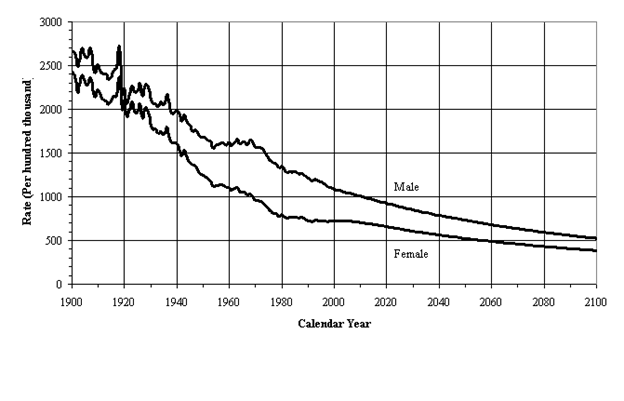
Figure 1—Age Adjusted Central Death Rates

by Sex and Calendar Year

U.S. Census longevity tables. 

            Basically, the death rate fell from about 2,500 per 100,000 people in the first two decades of the 20th century to about 1,000 (male) and 700 (female) per 100,000 people in the first two decades of the 21st Century.  Progress, no? 

A number of extremely important developments have contributed to the rapid average rate of mortality improvement during the twentieth century. These developments include:

  • Access to primary medical care for the general population.  NB: The “medical revolution” from the mid-19th Century on, then the creation of systems of medical insurance. 
  • Improved healthcare provided to mothers and babies.
  • Availability of immunizations.  NB: First, Edward Jenner and his successors, then “Big Pharma.” 
  • Improvements in motor vehicle safety.  NB: First, Ralph Nader, then the National Highway Traffic Safety Administration. 
  • Clean water supply and waste removal.  NB: Municipal water and sewage systems created from the later 19th Century onward.  See also: the “medical revolution.” 
  • Safer and more nutritious foods.  NB: First, Upton Sinclair, The Jungle, then the Food and Drug Administration.  No more finding a severed human thumb in your block of chewing tobacco—when it’s too late. 
  • Rapid rate of growth in the general standard of living.  NB: First, Industrialization, then the “distributive state.” 

Each of these developments is expected to make a substantially smaller contribution to annual rates of mortality improvement in the future.  [NB: That is, these improvements have squeezed out most of their gains, so progress will move at a slower pace. 

Future reductions in mortality will depend upon such factors as:

  • Development and application of new diagnostic, surgical and life sustaining techniques.
  • Presence of environmental pollutants. NB: The Environmental Protection Agency.
  • Improvements in exercise and nutrition.  NB: grocery shop around the outer rim of the store; got to the gym or go for a walk. 
  • Incidence of violence.  NB: Homicide rates have fluctuated a good deal, but we live in a less violent society than we once did.  Roger Lane, Murder in America: A History (1997) is a good guide.  Lane argues that the late 19th-early 20th Century drop in murder rates owed a lot to the creation of ordering institutions (like schools) that taught emotional repression, and the creation of lots of jobs that rewarded steadiness. 
  • Isolation and treatment of causes of disease.  NB: By “isolation” I take them to mean “identification.”  That’s produced by scientific research.  Metastatic breast cancer killed my first wife.  I would really like it if somebody made it go away. 
  • Emergence of new forms of disease.  NB: It’s going to happen.  See: Covid; see: Laurie Garrett, The Coming Plague: newly emerging diseases in a world out of balance (1994) and Betrayal of Trust: the Collapse of Global Public Health (2003). 
  • Prevalence of cigarette smoking.  NB: There’s already a lot less of it than there used to be.  Unless you live in China of course. 
  • Misuse of drugs (including alcohol).  NB: JMO, but I think most people have a “dimmer switch” when it comes to non-opioid drugs and alcohol, but some people only have an “on-off” switch.  How to tell the difference before the problem gets serious and what to do about it?  In any event, temperance societies did a lot to reduce alcohol abuse during the 19th Century, but Prohibition just made people angry and defiant.  Lesson here? 
  • Extent to which people assume responsibility for their own health.  NB: There are limits to what the government can compel you to do. 
  • Education regarding health.  NB: Sure put a dent in smoking.  Why is over-eating leading to Type II diabetes different?  Seems to be and Ozempic-type stuff may be the best treatment for now. 
  • Changes in our conception of the value of life.  NB: Sad to say, this murky phrase beats me. 
  • Ability and willingness of our society to pay for the development of new treatments and technologies, and to provide these to the population as a whole. 

NB: All of this collides with the current crisis of authority being suffered by elites, experts, and expertise.  Perhaps that is just a mood and will pass.  But there have been real failings among elites and experts.[2]  Perhaps those failings will need to be addressed before confidence in elites and experts can be re-established. 


[1] See: Life Tables 

[2] The opioid epidemic (1990s onward); the failure to discern or prevent 9/11/2001; the decision to attack Iraq, then the botched occupation (2003); the housing market bubble and the resulting financial crisis (2008-2009), followed by the “Great Recession”; the “replication crisis” in natural and social sciences (2010s onward); the problematic management of China’s participation in the World Trade Organization (2001 to the present).  Just a start at a list.