Staircase or Slide?

            Mandy Rice-Davies, a secondary figure in the “Profumo scandal,” later described her life as “one slow descent into respectability.”[1]  That’s pretty much the conventional view of aging.  More than a decade ago, one student of epigenetics[2] argued that aging became linear after puberty.[3]  Or, as a friend once remarked, “Once an adult and twice a child.” 

            Modern Science is beginning to have doubts.  In place of a slow descent along a glide path leading to your children abandoning you in your wheel-chair at the dog track, it has been suggested that aging happens in more-or-less predictable “bursts.”[4]  One study[5] analyzed molecular changes from blood samples.  What the researchers discovered was that at around age 44 bodies experienced molecular changes in muscle function and the metabolization of fat and alcohol.  At around age 60, more changes occurred in muscle function and in immune dysfunction.[6]  It is posited that the changes may explain why people have more trouble processing alcohol after age 40 and why they become more vulnerable to illnesses after age 60.

            Of course, poor life-style choices around diet and exercise appear to play a large role in progressive ill-health.[7]  Do the poor choices produce the metabolic changes?  Well, studies of mice found “sudden chemical modifications to DNA” happened in early-to-mid life and again in mid-to-late life.  Probably not a huge share of obese, alcoholic mice.[8]  Similarly, a study of blood plasma from 4,000 participants showed spikes of proteins linked to aging in the fourth, seventh, and eighth decades of life. 

            So far, researchers haven’t discovered any major ways to countering or controlling aging.  That would be to ask too much of Science at this early stage.  Are there significant differences between individual humans?  Are there significant differences between men and women?  Can anything significant be done to slow aging?  More work needs to be done. 

            Then there’s the $64 question: can anything be done to understand and control cognitive decline?  Who wants to be some “fine figure of a man” with his feeding instructions tattooed on his forehead for the convenience of the para-professionals? 


[1] On Rice-Davies, see: Mandy Rice-Davies – Wikipedia; on the “Profumo affair,” see: Profumo affair – Wikipedia 

[2] Epigenetics – Wikipedia  You’re probably going to want to skip right down to the “Functions and Consequences” section. 

[3] Mohana Rabindrath, “Aging in Adulthood May Occur in a Series of Bursts,” NYT, 18 March 2025.

[4] Mohana Rabindrath, “Aging in Adulthood May Occur in a Series of Bursts,” NYT, 18 March 2025. 

[5] Of 108 subjects spanning ages 25 to 75 years old.  If they were testing in 5-year groups (25-30-35 etc.), then that’s 11 groups.  Basically 10 subjects per group.  Really thin to my mind.  If they’re testing in 10-year groups (25-35-45 etc.), then that’s 20 guys per group.  Still really thin.  So, you’re entitled to go “In a pig’s eye; come back when you’ve got a real study.”

[6] Spoiler Alert: I’m 71 according to the government.  I don’t feel like whatever I imagined being 71 felt like.  Also, there’s a guy in my workout group who has the nickname “Spoiler.”  Naturally, all his online posts are labeled “Spoiler Alerts.” 

[7] More of Same on Longevity. | waroftheworldblog 

[8] Although there is probably some grad student betting his career on such studies. 
More of Same on Longevity.

            “Old age is a ship-wreck.”—Charles de Gaulle.  It sure is for a large percentage of Americans.  As adults, better than half have some chronic illness (cancer, heart disease, diabetes).  By the time they hit the traditional retirement age (65), four-fifths of them have at least two chronic conditions.  Only a handful reach age 80 without some sort of health problem. 

            How does this handful dodge so many of the bullets that hit the vast majority of people?  Dr. Eric Topol, a cardiologist interested in aging and longevity sought answers.  He hypothesized a genetic explanation.  That didn’t pan out, so he turned his attention to common features of what he calls “Super Agers.”[1]  He and his team of researchers found the “super agers” to be “thinner, exercised more frequently and seemed “remarkably upbeat,” often with rich social lives.”[2] 

            In Topol’s view, “nothing surpasses regular exercise for promotion of healthy aging.”  Then, “healthy eating and a good night’s sleep are also crucial.”  He’s less prescriptive about what to eat than are some, but he’s hard and fast on what not to eat: highly processed junk.  These “foods” promote inflammation, which can contribute to all sorts of other maladies. 

Then there’s loneliness (“social isolation” in academese).  No one to talk to about your triumphs or disasters.  No one to share your enthusiasms.  There’s probably an up-side here to sports fans.  (Bound to be one.  Well, that’s a snotty thing to say.)  It’s been a problem for a long time.  Popular culture commonly associated lonely with individual experience, rather than as a social problem.[3]  Back in 2018, British Prime Minister Theresa May appointed a “Minister for Loneliness.”  I don’t know what became of that initiative, but at least people recognized the seriousness of the problem.  Similarly, Vivek Murthy, the Surgeon General of the United States, warned of loneliness as a health issue.[4]    

            Topol is pretty much dismissive of many pseudo-scientific approaches to extending lifespan and health span, or improving cognitive function.[5]  OTOH, he sees drugs like Ozempic as having an “extraordinary potential to promote health span.”  The drugs both promote weight loss and reduced inflammation. 

            Many authors are now touting the opportunities for longer life and better health available to individuals making the right choices.  That would seem to imply that shorter life and ill-health are the product of individuals making bad choices.  Why does such a large share of Americans make such poor choices and then stick to them?  The machinations of “Big Food”?  A cultural shift from personal responsibility and self-reliance to feelings of impotence and dependence in “mass society”?  Or, conversely, a shift from a coercive, normative society to a laissez-faire and diversity-celebrating society?  The internet may not be the cause of loneliness, but it seems to be an accelerant.

            Be that as it may, there’s a cardinal sitting on the planter in my yard.  Dark red head, then a dustier sort of red below it.  Beautiful. 


[1] Eric Topol, Super Agers: An Evidence-Based Approach to Longevity (2025). 

[2] David Shaywitz, review of Topol, Super Agers, WSJ, 7 May 2025. 

[3] Couple of my favorites: Sea of Heartbreak and I Still Miss Someone 

[4] U.K. Appoints a Minister for Loneliness – The New York Times; and A Rao, “US surgeon general warns of next public health priority: loneliness”, The Guardian, 2 May 2023. 

[5] Still, they’re all over the commercials during the network news at dinner time.  As best I recall. 

Making Your Life Longer and Better.

            There’s life span and then there’s health span.[1]  How to prolong both?  There are some simple and cheap things to do. 

            First, work out.  Stan Pocock[2] once told a bunch of young men that “It’s not about the rigging, it’s about the rowing.”  He meant that the exercise equipment doesn’t matter, but how and how hard you do the exercise does matter.  So, what works?  Both cardio and strength training cut the risk of cardiovascular disease.  You know, heart attacks and strokes.  Walking and running around the neighborhood provides cardio.  Body weight calisthenics provide good, basic strength training.  Later, you can scale up with some weights if you’ve a mind to.  OTOH, 28-pound cinder blocks are $2.18 a piece at Loew’s. 

            How much exercise?  Well, anything is better than just sitting in the Barcalounger with a beer in your fist.  More formally, 150 minutes a week of “moderate” intensity aerobic exercise provides a baseline.  Walking 30 minutes a day, five days a week, gets you to 150 minutes.  After that base, 75 minutes of “vigorous” aerobic activity from running or swimming is a desirable further goal. 

            If you don’t like working out alone and don’t find a gym much of an improvement, then try a free exercise group available in much of the country.[3] 

            Second, eat some version of the Mediterranean diet.  That means eating unprocessed whole foods like whole grains, fruit and vegetables, and lean proteins (chicken and fish for example).  These kinds of diets can cut the risk of cardiovascular disease.  When shopping, work around the outside edge of the grocery store. 

            Third, try to get seven hours of sleep a night.  During sleep, the body regulates hormone and blood sugar levels.  Also, your brain can clean out toxins. 

            The best approach is to build a regular sleep schedule.  If you have to be up by 5:00 AM, then you have to be asleep by 10:00 PM.  Some people and early-birds, some are night-owls.  It’s probably shoveling sand against the tide to fight these traits.  So recognize their power when figuring out when to go to sleep and when to wake.  Then, you have accommodate your work schedule, your family responsibilities, and your exercise schedule to your sleep schedule.  In the case of work and family, they can easily take precedence.  Who knew that such standard aspects of life could threaten your health?  It’s a conundrum. 

            Fourth, “train your brain to be optimistic.”  Depression and loneliness are mental states that increase the risk of early death.  Perhaps people can train their brains to be more optimistic.  The current scientific research is only suggestive, rather than definitive.  It is suggested that talk therapy and journaling can help re-direct the mind.  Equally or more important, at least intuitively, is positive connectedness to other people.  Such connections reduce stress and improve mood.  OTOH, “negative” connectedness—spending time with people who run you down—has a bad effect.  Track the changes in how you feel that come from changes in how you live.  Feeling more fit, better fed, more rested, and more connected can shape attitude. 


[1] Mohana Ravindranath, “Inexpensive Longevity ‘Hacks’,” NYT, 15 April 2025. 

[2] Rowing legend Stan Pocock dies at 91 | The Seattle Times 

[3] F3 Nation: Fitness, Fellowship, Faith 

American Death Rates and the Improvement Thereof.

            I’m just copying this from a reliable source[1] that might not have come to your attention.  Some explanatory annotations have been added.  These are identified by “NB:” 

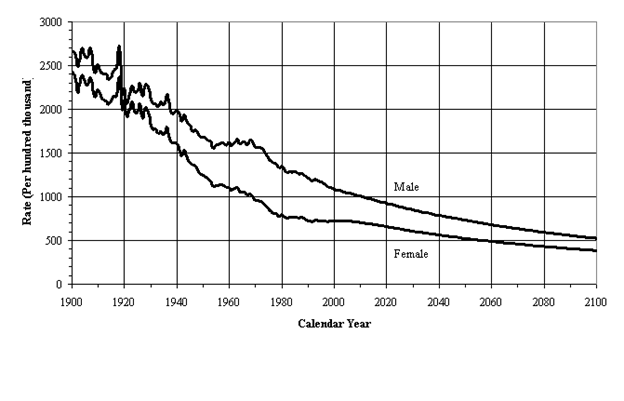
Figure 1—Age Adjusted Central Death Rates

by Sex and Calendar Year

U.S. Census longevity tables. 

            Basically, the death rate fell from about 2,500 per 100,000 people in the first two decades of the 20th century to about 1,000 (male) and 700 (female) per 100,000 people in the first two decades of the 21st Century.  Progress, no? 

A number of extremely important developments have contributed to the rapid average rate of mortality improvement during the twentieth century. These developments include:

  • Access to primary medical care for the general population.  NB: The “medical revolution” from the mid-19th Century on, then the creation of systems of medical insurance. 
  • Improved healthcare provided to mothers and babies.
  • Availability of immunizations.  NB: First, Edward Jenner and his successors, then “Big Pharma.” 
  • Improvements in motor vehicle safety.  NB: First, Ralph Nader, then the National Highway Traffic Safety Administration. 
  • Clean water supply and waste removal.  NB: Municipal water and sewage systems created from the later 19th Century onward.  See also: the “medical revolution.” 
  • Safer and more nutritious foods.  NB: First, Upton Sinclair, The Jungle, then the Food and Drug Administration.  No more finding a severed human thumb in your block of chewing tobacco—when it’s too late. 
  • Rapid rate of growth in the general standard of living.  NB: First, Industrialization, then the “distributive state.” 

Each of these developments is expected to make a substantially smaller contribution to annual rates of mortality improvement in the future.  [NB: That is, these improvements have squeezed out most of their gains, so progress will move at a slower pace. 

Future reductions in mortality will depend upon such factors as:

  • Development and application of new diagnostic, surgical and life sustaining techniques.
  • Presence of environmental pollutants. NB: The Environmental Protection Agency.
  • Improvements in exercise and nutrition.  NB: grocery shop around the outer rim of the store; got to the gym or go for a walk. 
  • Incidence of violence.  NB: Homicide rates have fluctuated a good deal, but we live in a less violent society than we once did.  Roger Lane, Murder in America: A History (1997) is a good guide.  Lane argues that the late 19th-early 20th Century drop in murder rates owed a lot to the creation of ordering institutions (like schools) that taught emotional repression, and the creation of lots of jobs that rewarded steadiness. 
  • Isolation and treatment of causes of disease.  NB: By “isolation” I take them to mean “identification.”  That’s produced by scientific research.  Metastatic breast cancer killed my first wife.  I would really like it if somebody made it go away. 
  • Emergence of new forms of disease.  NB: It’s going to happen.  See: Covid; see: Laurie Garrett, The Coming Plague: newly emerging diseases in a world out of balance (1994) and Betrayal of Trust: the Collapse of Global Public Health (2003). 
  • Prevalence of cigarette smoking.  NB: There’s already a lot less of it than there used to be.  Unless you live in China of course. 
  • Misuse of drugs (including alcohol).  NB: JMO, but I think most people have a “dimmer switch” when it comes to non-opioid drugs and alcohol, but some people only have an “on-off” switch.  How to tell the difference before the problem gets serious and what to do about it?  In any event, temperance societies did a lot to reduce alcohol abuse during the 19th Century, but Prohibition just made people angry and defiant.  Lesson here? 
  • Extent to which people assume responsibility for their own health.  NB: There are limits to what the government can compel you to do. 
  • Education regarding health.  NB: Sure put a dent in smoking.  Why is over-eating leading to Type II diabetes different?  Seems to be and Ozempic-type stuff may be the best treatment for now. 
  • Changes in our conception of the value of life.  NB: Sad to say, this murky phrase beats me. 
  • Ability and willingness of our society to pay for the development of new treatments and technologies, and to provide these to the population as a whole. 

NB: All of this collides with the current crisis of authority being suffered by elites, experts, and expertise.  Perhaps that is just a mood and will pass.  But there have been real failings among elites and experts.[2]  Perhaps those failings will need to be addressed before confidence in elites and experts can be re-established. 


[1] See: Life Tables 

[2] The opioid epidemic (1990s onward); the failure to discern or prevent 9/11/2001; the decision to attack Iraq, then the botched occupation (2003); the housing market bubble and the resulting financial crisis (2008-2009), followed by the “Great Recession”; the “replication crisis” in natural and social sciences (2010s onward); the problematic management of China’s participation in the World Trade Organization (2001 to the present).  Just a start at a list. 

A lovely day in the neighborhood.

Social scientists contend that the location in which a child grows up correlates with their adult fate.[1]  On the one hand, there is adult income.[2]  One experiment that ran from 1994 to 1998 offered people living in public housing the opportunity to enter a lottery.[3]  Winners in the lottery received vouchers to help pay the rent if they moved to other areas.  The children of lottery winners (if they moved early enough) far outpaced the children of losers in subsequent earnings.[4]

The sequential demolition of the vast Robert Taylor Homes in Chicago between 1995 and 1998 displaced both those who did want to move and those who did not want to move.  All had to go and all received housing vouchers.  Comparing those who moved—willingly or unwillingly—with those who remained behind, economists have found that a) those who moved were 9 percent more likely to be employed than those who remained behind; and b) they earned 16 percent more than those who remained behind.

Then there is life-span.[5]  Rich people have lived longer than poor people for quite a while.  At the start of this century the average billionaire lived 12 years longer than the average street-person.  Today the gap has widened to 15 years.  Social scientists (and, for all I know, anti-social scientists or just the John Frink, Jr.s of this world) have documented that there is a very uneven distribution of extra years among poor people.  The poor in some places live almost as long as the rich, but they die young in other places.  On average, poor men in New York City live for 79.5 years; poor men in Gary, Indiana live for only 74. 2 years.

The studies suggest that altering the habits and attitudes of poor people in the blighted areas could extend lives.  First of all, in the housing-voucher lottery, only one-fourth of the people who were offered the chance to join the lottery did so.  Those who did apply have been characterized as “particularly motivated to protect their children from the negative effects of a bad neighborhood.”  This means that three-quarters of the people offered the chance to join the lottery were not “particularly motivated to protect their children.”

Then, moving to a better neighborhood increased likelihood of being employed by only 9 percent.  That’s better than nothing, but it isn’t much of a bump.  Moving to a better neighborhood increased lifetime earnings by 16 percent.  How much is that in dollar figures?  It’s $45,000.  Spread over a possible 40 year working life, that’s $1,125 a year and about $0.55 per hour.  Is it worthwhile for a family to leave behind everyone they know, a “system” that they know how to navigate, for this kind of money?

Second, the rich live in healthier ways than do some poor people.  They eat better, they exercise more, they are less likely to be obese, they usually don’t smoke, and they are unlikely to use opiods.  Even demanding, stressful jobs don’t make them feel more stressed than do poor people.  Poor people often eat a poor diet, smoke, and don’t exercise (it’s hard running 5 miles if you’re a smoker). Diet propaganda, parenting education, anti-smoking campaigns, and adult exercise programs could make a big difference.

To an uncertain extent then, poverty is volitional, a choice.  See: Juan Williams.

[1] That raises a question: does the neighborhood itself cause this effect or do people with other characteristics and experiences just end up in certain kinds of neighborhoods?

[2] Given social class segregation, it isn’t readily apparent why this isn’t the same as saying that the social class in which a child grows up has a large effect on their adult income.  Maybe it’s just NewSpeak.

[3] Justin Wolfers, “Bad Neighborhoods Do More Harm Than We Thought,” NYT, 27 March 2016.

[4] However, another experiment found virtually no difference in outcomes between winners and losers.

[5] Neil Irwin and Quoctrung Bui, “Where the Poor Live in America May Help Determine Life Span,” NYT, 11 April 2016.