No more coals to Newcastle.

            By the mid-Thirties the international situation had begun to darken.  It was not yet Desperate.  The worst—another World War—might still be avoided.  Serious men had to deal with situations in a realistic way.  What were the situations? 

First, there was the conflict between the “democratic” and “status-quo” powers (Britain, France, and the United States) and the “authoritarian” and “revisionist”: powers (Nazi Germany, Fascist Italy, Communist Russia, and Imperial Japan.  Each of the “revisionist” powers desired to expand its territorial control over adjoining areas.  To accomplish these goals they would have to overthrow the system of international order—often called the Versailles settlement—created after the First World War.  Beyond that common goal they were often at odds among themselves. 

            Second, there were the military realities.  The conventional economic policy adopted to respond to the Depression (1929-1939) combined lower taxes with spending cuts, while limiting international trade (autarky).  Where countries stuck with this policy, military budgets suffered.  Where they did not stick with this policy, they rearmed faster.  Meanwhile, autarky spurred both isolationism and aggression.

            Third, Britain had three enemies threatening its global position: Germany in Europe, Italy in the Mediterranean, and Japan in the Far East.  It had the military resources to fight one major war at a time.  Britain lacked good allies.  America was deeply isolationist; Communist Russia hated capitalist counties—democratic or authoritarian; and France had been “bled white” in the First World War, while the Depression intensified partisan polarization.  If Britain fought one major power, the other two enemies would pile on.  Unless they were bought off or deterred. 

            In July 1934, Austrian Nazis had tried to seize power.  Hitler’s fingerprints were all over the failed coup.  The Italian dictator Benito Mussolini ordered four army divisions to the border with Austria to deter German intervention.  In London and Paris, this seemed a good omen. 

            In March 1935, Nazi Germany declared that it would begin rearmament in violation of the Versailles Treaty.  In April 1935, representatives from Britain, France, and Italy met in the resort town of Stresa.  They agreed to resist any further German violation of the Versailles Treaty.  During the conference, the Italians raised the issue of Ethiopia.  Italy wanted to take over a big chunk of Ethiopia.  This was Italy’s bill for helping contain Germany.  The demand embarrassed the British, so it never made it into a written agreement.    

Mussolini had not abandoned his goals.  In October 1935, Italy invaded Ethiopia.  Public opinion, but especially “progressive” opinion, in both Britain and France went wild.  Demands rang out for support for the League of Nations and economic sanctions on Italy. 

British and French leaders still hoped to save the Italian alliance against Germany.  In December 1935, British Foreign Secretary Sir Samuel Hoare met secretly with French Foreign Minister Pierre Laval.  They agreed on a plan that gave most of Ethiopia to Italy while leaving a fragment independent.  News leaked, public opinion revolted, the plan was abandoned, and Hoare resigned.  King George V said “Ah well Sam, no more coals to Newcastle, no more Hoares to Paris.” 

Lesson: If you want the “status quo” in one area you may have to accept “revisionism” in another.  Who is the main enemy?  What are the alternatives? 

Diary of the Second Addams Administration 5.

            From the adoption of the Constitution until 1974, Presidents were assumed to have the power—inherent in their office–to not spend money appropriated by Congress.[1]  In 1801, Thomas Jefferson chose to prioritize debt reduction over national defense.  He impounded $50,000 that had been appropriated for gunboats requested by the Navy.  Many of his successors impounded funds. 

By the early 1970s, members of Congress believed that President Richard Nixon was abusing his official powers in a variety of ways.  One example came in his impoundment of appropriated funds.  Nixon held up spending on “water pollution control, education and health programs and highway and housing construction.”[2]  The amount came to “$53.2‐billion during its first five years in office.”[3]  In the context of other struggles with President Nixon, House Speaker Carl Albert called it a struggle between Congress and “one-man rule.”  On a broadly bipartisan basis, Congress struck back.  The Congressional Budget and Impoundment Control Act of 1974 barred the President from impounding funds appropriated by Congress.[4]  It did permit a Presidential request for “rescission” if approved by Congress.[5]  Already mired in “Watergate,” Nixon signed the bill into law.  As a result of Nixon’s surrender, the law was never tested before the Supreme Court.  Do extreme cases make good law? 

That doesn’t mean that Presidents think that impoundment is a bad idea.  Presidents Ronald Reagan, Bill Clinton, George H. W. Bush, George W. Bush, and Barack Obama all supported the restoration of the authority stripped from the office because of that damn fool Nixon.  Other unsuccessful candidates for President—John McCain, Al Gore, and John Kerry—supported restoring the authority to impound.[6]   

Which brings us to President Trump.  During the campaign, he promised to “squeeze the bloated federal bureaucracy for massive savings.”[7]  From the get-go he stopped appropriated spending on D.I.E. initiatives; payments to non-governmental organizations; foreign aid (for a 90 day review period); and all federal loans and grants (almost immediately rescinded).  Trump wants to bring the issue to the Supreme Court for the hearing it didn’t get in the 1970s. 

The key issue here is self-restraint.  The ballooning national debt, fueled by unbalanced annual budgets, threatens the financial stability of the government.  Nixon’s abuse of the powers of his office went well beyond what other presidents had done, alarming many people in both parties.  Trump seems determined to disrupt the established “way we do things around here” patterns that have taken the United States to the brink of multiple crises.  He, too, is alarming people in both parties.  He wouldn’t be on the verge of shifting the balance of power if all of us had shown more self-restraint.  Not meant as an exculpation of Trump.   


[1] Impoundment of appropriated funds – Wikipedia 

[2] Richard D. Lyons, “Nixon’s Impounding of Billions in Federal Money Is Complicated Issue, Abounding in  Misconceptions,” NYT, 7 October 1973. 

[3] Compared to $39 billion impounded by Lyndon Johnson. 

[4] Passed by the House 385-23 (204 Democrats and 181 Republicans voting in favor); passed by the Senate 80-0 (50 Democrats and 29 Republicans). 

[5] Since then, Congress has rarely approved rescission requests, so Presidents rarely request them.     

[6] President Joe Biden did not.

[7] Charlie Savage, “Are Presidents Empowered to Block Spending Authorized by Congress?” NYT, 29 January 2025. 

American attitudes toward immigration.

            We are all immigrants or the descendants of immigrants.[1]  Yet “Americans” have often been ambivalent about—or hostile to—new arrivals.  In the 17th Century Native Americans made repeated attempts to wipe out English settlers.  The early European settlements, especially those of the English, were starved for settlers.  They generally welcomed newcomers with open arms. 

            After independence from Britain had been won, the new United States had to define its own policy on immigration.  Generally, the new nation desired immigrants.  Immigrants could bring valuable skills, and the labor to transform the continent’s abundant resources into national wealth.  All residents enjoyed the same civil and legal rights.  The initial residency requirement for citizenship was two years, later set at five years.  No one coerced them to abandon their own culture, or even language. 

            In the 1830s began a great wave of immigrants, predominantly Germans and Irish.  Trouble arose from the reality that “new” Americans were not immediately and might never be “real” Americans in the eyes of the “old” Americans.  Increasingly, the “voluntary” Americans were drawn from countries where absolute monarchy prevailed.  This included all those who belonged to the “absolute monarchy” of the Papal Catholicism.[2]  Other American feared the United States would be swarmed by left-wing radicals in flight from more repressive regimes. 

“Nativism” arose as a political force, culminating in the American or “Know Nothing” Party in the 1850s.  They expressed Thomas Jefferson’s earlier fears that people raised under ana absolute monarchy could not learn how to participate in a democratic republic.[3] “Nativism” made impressive progress until swamped by the larger crisis of the Civil War. 

After the Civil War, as any textbook will tell you, the country bounded forward in both industrialization and the exploitation of the Trans-Mississippi West.  Vast amounts of natural resources (minerals, timber, grains and livestock) just needed manpower to put them to work.  British, German, Irish (and French-Canadian in New England) immigrants poured in.  Anti-Catholicism, anti-Semitism revived, and a new anti-Socialism joined them as inspirations to immigrants.  Then, in the 1880s, there began a tidal wave of “new immigration” from Southern and Eastern Europe.  Poles, Russian Jews, Italians, Hungarians, Greeks, and others arrived in huge numbers.  Only the First World War (1914) paused most European emigration. 

This latter immigration stirred bubbling cauldron of late-19th and early-20th Century social, economic, cultural, and political strife.  Both “advanced” thinkers and organized labor championed the limits; but equivalent figures argued for inclusion over exclusion.  The contest produced the first laws restricting European immigration (1923-1924).   The laws have been revised on several occasions, but the United States has been a country of regulated and restricted immigration for a century.  Recently, mass defiance of the law has combined with important political and economic forces turning a blind eye to the issue has made it an explosive problem. 

So, we go back and forth in a debate that is ever-changing and ever-the-same. 

See: Oscar Handlin, The Uprooted; Roger Daniels, Guarding the Golden Door. 


[1] Including those whose ancestors crossed the Bering land bridge when it was still above sea level.  

[2] The “Syllabus of Errors” (1877) summed up more than a century of Papal anti-modern, anti-republican, and anti-liberal thought.  “He was agin it,” as Will Rogers said of a fundamentalist Protestant preacher’s views on sin. 

[3] Jefferson came down on both sides of many issues.  This is one such. 

Civil Society.

            “The order [halting government payments to external bodies] sparked chaos at universities, charities, local government, and other bodies reliant on federal funding,…”[1]  Sort of an off-the-cuff statement that arouses no alarm unless your ox is one of those getting gored.  Still, it’s worth thinking about a little bit. 

            One way of thinking about the issues is the following.  Jurgen Habermas (1929– ) is a brilliant German philosopher.[2]  OTOH, so was Karl Marx.  What did that get us?  “Boiler suits, prison camps, and a damn long march to nowhere.”[3]  One of the many interesting ideas propounded by Habermas, on the basis of deep learning in a host of areas, is the distinction between the “public sphere” and the “private sphere.”  He defined the “public sphere” as “made up of private people gathered together as a public and articulating the needs of society with the state.”  The “private sphere,” in contrast, the place where “an individual enjoys a degree of authority and tradition, unhampered by interventions from governmental, economic or other institutions.”  Religion, family life, sexual relations in private are current examples of this “private sphere.”[4]   Taken together, they create “civil society.”  By “civil society” is meant “1) individuals and organizations in a society which are independent of the government or 2) the aggregate of non-governmental organizations and institutions that advance the interests and will of citizens.”[5] 

            In recent-for-me times, the Czech writer and dissident (even when he was in power), Vaclav Havel[6] used the term civil society to describe all the groups menaced by Communism’s relentless drive to subordinate every person and group into conformity with the state’s wishes. 

            Here’s the thing: “universities, charities, local government, and other bodies” is pretty much an operational definition of “civil society.” 

            The institutions of civil society are supposed to be “individuals and organizations in a society which are independent of the government.”  The fact that they are “reliant on federal funding” indicates just how deeply the institutions of “civil society” have been penetrated and compromised by the State.  With the money comes regulations, requirements, audits. 

 Yet, “the aggregate of non-governmental organizations and institutions” are supposed to “advance the interests and will of citizens.”  They are supposed to engage in discussion and even confrontation.  Hard to do when you’re the hired help. 

None of this is the product of a sinister conspiracy.[7]  It’s just convenience, then inertia. 


[1] “Trump orders cause whiplash in Washington,” The Week, 7 February 2025, p. 4. 

[2] Jürgen Habermas – Wikipedia

[3] Jim Prideaux in John Le Carre, Tinker, Tailor, Soldier, Spy (1974).    

[4] However, these things can shift over time.  For the Greeks and for Europeans in the Reformation, religion was a public concern that required continual and public assent, but the authorities didn’t much care if you whacked your kid.  “Boys have always been beaten and it would be a bad day for the world if boys ceased to be beaten.”  C.S. Forester, Lieutenant Hornblower.  The statement is made during the run-up to the murder of a sadistic Navy captain.

[5] See: https://en.wikipedia.org/wiki/Civil_society  NB: I reversed the order of the terms because I want to consider a particular point. 

[6] Guy reminds me a bit of Roger Williams.  Turn left when everyone else turns right.  Turn left because everyone else turns right.  “Let us honor if we can the vertical man, though we value none but the horizontal one.”—W.S. Auden. 

[7] Regardless of what Republican or Democratic activists may believe. 

American Death Rates and the Improvement Thereof.

            I’m just copying this from a reliable source[1] that might not have come to your attention.  Some explanatory annotations have been added.  These are identified by “NB:” 

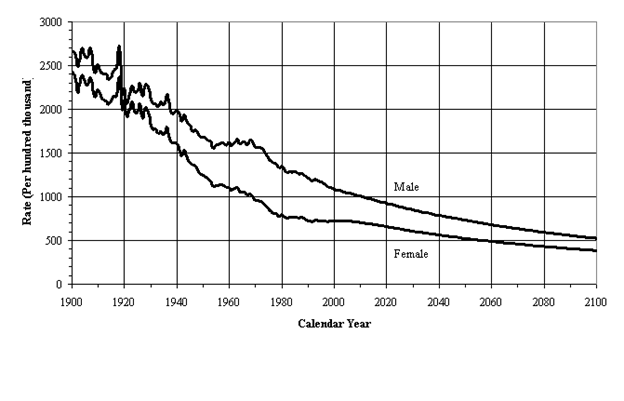
Figure 1—Age Adjusted Central Death Rates

by Sex and Calendar Year

U.S. Census longevity tables. 

            Basically, the death rate fell from about 2,500 per 100,000 people in the first two decades of the 20th century to about 1,000 (male) and 700 (female) per 100,000 people in the first two decades of the 21st Century.  Progress, no? 

A number of extremely important developments have contributed to the rapid average rate of mortality improvement during the twentieth century. These developments include:

  • Access to primary medical care for the general population.  NB: The “medical revolution” from the mid-19th Century on, then the creation of systems of medical insurance. 
  • Improved healthcare provided to mothers and babies.
  • Availability of immunizations.  NB: First, Edward Jenner and his successors, then “Big Pharma.” 
  • Improvements in motor vehicle safety.  NB: First, Ralph Nader, then the National Highway Traffic Safety Administration. 
  • Clean water supply and waste removal.  NB: Municipal water and sewage systems created from the later 19th Century onward.  See also: the “medical revolution.” 
  • Safer and more nutritious foods.  NB: First, Upton Sinclair, The Jungle, then the Food and Drug Administration.  No more finding a severed human thumb in your block of chewing tobacco—when it’s too late. 
  • Rapid rate of growth in the general standard of living.  NB: First, Industrialization, then the “distributive state.” 

Each of these developments is expected to make a substantially smaller contribution to annual rates of mortality improvement in the future.  [NB: That is, these improvements have squeezed out most of their gains, so progress will move at a slower pace. 

Future reductions in mortality will depend upon such factors as:

  • Development and application of new diagnostic, surgical and life sustaining techniques.
  • Presence of environmental pollutants. NB: The Environmental Protection Agency.
  • Improvements in exercise and nutrition.  NB: grocery shop around the outer rim of the store; got to the gym or go for a walk. 
  • Incidence of violence.  NB: Homicide rates have fluctuated a good deal, but we live in a less violent society than we once did.  Roger Lane, Murder in America: A History (1997) is a good guide.  Lane argues that the late 19th-early 20th Century drop in murder rates owed a lot to the creation of ordering institutions (like schools) that taught emotional repression, and the creation of lots of jobs that rewarded steadiness. 
  • Isolation and treatment of causes of disease.  NB: By “isolation” I take them to mean “identification.”  That’s produced by scientific research.  Metastatic breast cancer killed my first wife.  I would really like it if somebody made it go away. 
  • Emergence of new forms of disease.  NB: It’s going to happen.  See: Covid; see: Laurie Garrett, The Coming Plague: newly emerging diseases in a world out of balance (1994) and Betrayal of Trust: the Collapse of Global Public Health (2003). 
  • Prevalence of cigarette smoking.  NB: There’s already a lot less of it than there used to be.  Unless you live in China of course. 
  • Misuse of drugs (including alcohol).  NB: JMO, but I think most people have a “dimmer switch” when it comes to non-opioid drugs and alcohol, but some people only have an “on-off” switch.  How to tell the difference before the problem gets serious and what to do about it?  In any event, temperance societies did a lot to reduce alcohol abuse during the 19th Century, but Prohibition just made people angry and defiant.  Lesson here? 
  • Extent to which people assume responsibility for their own health.  NB: There are limits to what the government can compel you to do. 
  • Education regarding health.  NB: Sure put a dent in smoking.  Why is over-eating leading to Type II diabetes different?  Seems to be and Ozempic-type stuff may be the best treatment for now. 
  • Changes in our conception of the value of life.  NB: Sad to say, this murky phrase beats me. 
  • Ability and willingness of our society to pay for the development of new treatments and technologies, and to provide these to the population as a whole. 

NB: All of this collides with the current crisis of authority being suffered by elites, experts, and expertise.  Perhaps that is just a mood and will pass.  But there have been real failings among elites and experts.[2]  Perhaps those failings will need to be addressed before confidence in elites and experts can be re-established. 


[1] See: Life Tables 

[2] The opioid epidemic (1990s onward); the failure to discern or prevent 9/11/2001; the decision to attack Iraq, then the botched occupation (2003); the housing market bubble and the resulting financial crisis (2008-2009), followed by the “Great Recession”; the “replication crisis” in natural and social sciences (2010s onward); the problematic management of China’s participation in the World Trade Organization (2001 to the present).  Just a start at a list. 

Populo-phobia and Progresso-Normativity.

            Historians often read stuff from the many-days-ago.  While looking for something else, I came across a curious article.[1]  The article is an exercise in dystopic futurism.  It defines some terms; then extrapolates from events in the first half of the Twentieth Century. 

“Populo-phobia” is the hostility and disdain felt toward “the People” collectively asserting themselves against “the Elites.”[2]  Populism is often attacked as a collection of “anti” movements.  It is anti-elite, anti-intellectual, anti-complexity, anti-foreign, anti-change in some ways, and anti-system in the sense of believing that “working within the system” leads nowhere.     

“Progresso-normativity,” sprang from this “Populo-phobia.”  It is the concept that Progressivism is the “normal” political orientation.  It assumes a partisan binary in which Progressivism is empirically and morally correct and Populism is empirically and morally incorrect.[3] 

            Honey draws his evidence from the impact of the Depression and the Second World War.  First, the era witnessed a vibrant rhetorical faith in “democracy” combined with a suspicion of “the people.”  By the middle of the Twentieth Century, many examples could be offered of the ability of charismatic leaders to mobilize mass enthusiasm for destructive purposes.[4]

Second, there had been a huge expansion of government’s role.  On the one hand, this meant managing the economic environment to create material prosperity.  In this effort, independent central banks and, in some places, national planning authorities played an important role.  Government’s expanded role led to a great and continuing increase in bureaucracy.  This began to shift the balance of power between the Executive and Legislative branches of government.  On the other hand, the acceptance of social change through “social evolution” gave way to change promoted by public authorities.  This meant a turn to laws and courts (hence lawyers and judges), and regulations (hence experts and bureaucrats).  All these were seen as too complex for the ordinary understanding. 

Fourth, Honey applied the ideas of Italian Communist Antonio Gramsci to the modern elites.[5]  Gramsci argued that, through their control of media and education, the dominant minority sold its own values and culture to the mass of people.  The People’s acceptance of this culture made them conform, rather than resist.[6]  In this effort, education and the media are vital. 

Fifth, Honey conjectured that both the post-Second World War “G.I. Bill” and the foundation of the Educational Testing Service (1947) might create an enlarged and different “Elite.”  On the one hand, it could create a “Confucian” America where social advancement depended upon standardized examination testing.  On the other hand, Honey feared a compartmentalization of American society.  This might leave Progressive-Americans cut off from the lives of “ordinary” people. 

The effects of societal “Progresso-normativity” on Conservatives, Independents, and Populists has been labeled “Progressive privilege.”[7] 


[1] Theodore Honey, “Populo-phobia and Progresso-normativity,” Journal of Relatively Advanced Concepts, August 1948.

[2] This extends to individuals who self-identify or are read as being Populists. 

[3] To be fair, Honey also argues that Progressives view Conservatism as substantially unjustified. 

[4] That is, Mussolini, Hitler, Lenin, Stalin, and Mao. 

[5] On Gramsci, see Joseph Buttigieg, Gramsci’s Political Thought (1992). 

[6] To offer one example drawn from a later period, watch a few episodes of “All in the Family” (1971-83). 

[7] “Progressive privilege” is a sub-set of the larger concept of “Societal privilege.”  “Societal privilege” describes the advantages or benefits received by members of some groups which are denied to other groups.  These benefits, it is theorized, are received as a function of a person’s membership in such a group, rather than as a function of individual merit or action.  “Privilege” often runs hand-in-hand with various types of power: social, cultural, economic, and political.  However, people with some “privilege” tend to not understand that they are “privileged.”  They see themselves and the members of their group as “normal.”  “Privileged” people often deny the existence of an entrenched institutional “privilege.”  Those without “privilege” are seen as deviant.  That deviance may be either willful or the accidental result of misinformation. 

Remaking the Middle East 7 October 2024.

            It is a moment of great uncertainty in the Middle East.  Many people fear the expansion of Israel’s war with Hamas and Hezbollah into a larger war involving Iran and the United States, one which has no certain outcome.  For others, however, visions of sugar plums dance in their head.[1]  A Saudi Arabian journalist[2] wrote that Israel’s deadly attacks had done so much damage to Hezbollah that “even if the group were to live on, it would most likely be a caricature of its former self.”[3]  Lebanon may be able to free itself from the thirty-year death-grip of Hezbollah.  A British journalist judged that, in spite of the Biden administration dragging on Israel’s coat, “Israel is likely to see the current moment as too good an opportunity to miss.” 

Opportunity to do what?  One answer is to strike at the nuclear weapons program that threatens the survival of Israel.  Another answer is both more ambitious and ill-defined.  An American journalist reported that “Many in Israel see a ‘once-in-a-generation chance’ to remake the Middle East to Israel’s advantage.”  Naftali Bennett, a former Prime Minister of Israel, sees “the biggest opportunity in the past 50 years” to reshape the region.[4] 

Reshape how?  Destroy Hamas entirely?  Destroy Hezbollah entirely or, at least as a significant force in regional conflicts?  Gravely damage Iran’s nuclear program and force it to accept long-term international supervision?  Topple the Islamist regime in Iran entirely in hopes of something better emerging?  Forge an alliance with Saudi Arabia over the Iran conflict and relegate the Palestinian question to Israel alone?  Redraw the map of the Middle East to unite all Kurds not under Turkish rule into a sovereign state?  Redraw the map of the Middle East to assign the Sunni part of Iraq to Jordan?  “Transfer”[5] the Palestinians of Gaza and the West Bank to the Shi’ite portion of a partitioned Iraq?

            What does History tell us about once-in-a-generation opportunities? 

            In the early 19th Century, “Nationalism” meant that all people speaking the same language and sharing the same culture should live in a single independent country.  Germany were split into 30-plus states; Italy was split into half a dozen states; the Austrian Empire smooshed together people from many different latent-countries.  Many people saw Nationalism as the wave of the future.  Austria saw it as a death sentence.  One of these Believers was the French Emperor Napoleon III, the nephew of the great Napoleon I.  France should lead this remaking of the map of Europe. 

            Napoleon III started with Italy, concluding a secret deal with Count Camillo di Cavour, the prime minister of the Italian kingdom of Piedmont-Sardina.[6]  If Cavour would provide a war with Austria, Napoleon II would furnish the French army to win it.  Then, the Austrians would be expelled from Italy, and Italy would be “united” in a loose federation.  Piedmont would expand to dominate northern Italy; central Italy’s small states would join together under a ruler to be supplied by France; the backward southern Italian kingdom of the Two Sicilies would join the confederation; and the Pope’s lands would be much reduced, but the Pope would become head of this loose confederation. 

            Cavour did what he said that he would: he provoked Austria into declaring war.  Napoleon III did what he said that he would: his army thrashed the Austrians at Magenta and Solferino.  Then the wheels came off, badly and at high speed.  First, the French were appalled by the casualties suffered in battle and tried to crawfish on Piedmont by striking a deal with the Austrians.  Second, Italian popular nationalism surged up on the enthusiasm of victories won by others.  Popular revolts led to demands for the unification of all Italy north of the kingdom of Naples, regardless of promises made to Napoleon III.  Third, then the Italian nationalist and republican adventurer Giusseppe Garibaldi led a small expedition (with or without the knowledge of Cavour?) against the kingdom of the Two Sicilies.  The kingdom collapsed like a house of cards.  Garibaldi led his army north toward Rome.  Faced with the danger of a republican revolution overwhelming a monarchical revolution, the king of Piedmont met Garibaldi face to face.  The great man surrendered to the little king, at the price of southern Italy being included in the new nation. 

            France hadn’t wanted a united Italian peninsula unified under a centralized government.  The northern Italians hadn’t really wanted the inclusion of the backward Kingdom of the Two Sicilies in their new nation.  Garibaldi hadn’t wanted a monarchy, but a unified and centralized republic.  No one got exactly what they wanted. 

            Nor did they clearly foresee the long-term effects. The unification of Italy made the unification of Germany (against and without the Austrian empire) the next pressing question in European affairs.  Nationalist victories in central Europe then accelerated the spread of nationalism into the great multi-national empires of eastern Europe and the Middle East.  The Austrian, Russian, and Ottoman empires all succumbed during the First World War. 

            Otto von Bismarck, the Prussian statesman and leader of German unification, was a temperamentally conservative and cautious person.  He spent a lot of time thinking about all the possible scenarios, but he didn’t go looking for “once-in-a-generation” chances. 

            Of course, other people are more time-bound and fixated on one outcome as the only possible outcome.  That is, they feel a burning need to accomplish some great mission in their lifetime.  Both Lenin and Hitler were that way. 


[1] Marc Champion wrote in Bloomberg that the blows suffered by Iran offer a tempting chance for Israel to inflict serious harm on its avowed main enemy.  Champion acknowledged that an Israeli attack would force Iran to choose between humiliation for the regime and a war with a surprising adversary and the possibility of American involvement. 

[2] A place where speech is never free, but often inspired. 

[3] Faisal Abbas, quoted in “Lebanon: Can Hezbollah survive the death of its leader?” The Week, 11 October 2024, p. 15. 

[4] All quoted in “Israel vows retaliation after Iranian attack,” The Week, 11 October 2024, p. 4. 

[5] At the end of and after the Second World War, many ethnic Germans fled the advancing Red Army or were driven out of places like Poland and the Czech Sudetenland.  These and other population movements were sometimes referred to as population “transfers.” 

[6] Derek Beales and Eugenio Biagini, The Risorgimento and the Unification of Italy (2003).  It’s an update of an earlier work.  But, if you have the time, there are a series of classic older books by Denis Mack Smith. 

Movies About War at Sea: Bear With Me Here.

            C.S. Forester (1899-1966)[1] was rejected when he volunteered for military service during the First World War.[2]  He tried med school, but left without the MD.  He tried writing.  This time he got what he wanted.  Forester discovered “write fast, send it off, and start something new—you’ll learn as you go.”  In 1922 he started a relationship with Methuen publishers that led to four popular history books.[3]  In 1924, he published two little noticed novels; in 1926 he hit pay-dirt with Payment Deferred; in 1927 he wrote two more little-noticed novels, and a third in 1928; in 1929 he hit pay-dirt again with Brown on Resolution; in 1930 and 1931 he wrote two more little-noticed novels; then in 1932 and 1933 he wrote two successful historical novels, Death to the French,[4] and The Gun.[5]  Then, suddenly, he was successful.  He got a contract to spend a quarter of each year in Hollywood working on screen-plays.  In 1935, “Brown on Resolution” became a movie[6]; he published both the still highly-regarded The General and The African Queen (and the soon-forgotten The Pursued).   In 1937 and 1938 he published the first three novels in the “Horatio Hornblower” series.[7]  These books launched a string of a dozen works that dominated his later career.  Not knowing this in advance, in 1940 he wrote To the Indies, about Spanish conquistadors. 

            Then the Second World War came.  He had missed “doing his bit” in the first war; he wasn’t going to miss it this time.  He couldn’t soldier, but he could write.  By 1938, he had created a series of British characters who were stolid, courageous, undeterred by adversity, and inventive about overcoming it.  He had mastered the action scene.[8]  The British Ministry of Information sent him to America.  “You’ve been there, you know them, make us sympathetic, eh what?”[9] 

            So he moved to the United States.  Lippity-lippity quick like a bunny, he wrote another novel about war in the Age of Fighting Sail.  This time, the Hero-Captain was an American during the War of 1812.[10]  It turns into a story of Anglo-American friendship developing in wartime.  Timely, huh?  Appearing in Summer 1941, it was a huge hit with critics and readers.  He wrote a magazine story about Americans flying in the RAF while the United States remained neutral.  It got made into a successful movie.[11]  He wrote a magazine story about Commando raids on occupied Europe.  It got made into a movie.[12]  In 1942-1943, the Royal Navy took him along on missions.  A trip on H.M.S. Penelope during a convoy to Malta resulted in the trim little fact-based novel The Ship (1943).[13] 

            After the war he stayed in America.  He continued the Hornblower series to completion.[14]  He also wrote a bunch of other stuff.  In part, he wrote a different kind of fiction.  The Sky and the Forest (1948) seems to me like the inspiration for Chinua Achebe, Things Fall Apart (1958).  Or perhaps Achebe just reacted against the White man’s view of Africa, like he did with Joseph Conrad and Joyce Cary.  But that’s just me.  Randall and the River of Time (1951) is a bit of a head-scratcher, but it seems to me a riff on Ecclesiastes 9: 11-12.  In part, the cobbler returned to his last, writing The Naval War of 1812/The Age of Fighting Sail (1957) about the naval side of the War of 1812; and Hunting the Bismarck/The Last Nine Days of the Bismarck/Sink the Bismarck (1959).[15] 

Among that “other stuff” is The Good Shephard (1955).  The book brings together The Captain from Connecticut and The Ship.  That is, it is the story of an American Captain commanding the escort vessels of a convoy crossing the Atlantic in the face of ferocious U-boat attacks early in 1942.  From this novel came the movie “Greyhound.” 


[1] I think that I had read all his “Hornblower” books by the time he died.  I was then twelve years old. 

[2] Only a serious medical problem would get you rejected by the British Army in 1917-1918. 

[3] Victor Emmanuel II (1922); Napoleon and His Court (1922); Josephine, Napoleon’s Empress (1925); Victor Emmanuel II and the Union of Italy (1927); Louis XIV, King of France and Navarre (1928). 

[4] OK, this has a funny side to it.  In America, it was titled Rifleman Dodd and its central character is Rifleman Matthew Dodd.  He is a soldier in the 95th Regiment of Foot who becomes separated from his unit during Sir Arthur Wellesley’s retreat to the Lines of Torres Vedras.  There is also a Rifleman Matthew Dodd who becomes separated from his unit in the 95th Regiment of Foot during Sir John Moore’s retreat to Coruna.  He appears in Bernard Cornwell, Sharpe’s Escape (2004).  Not an accident. 

[5] Very loosely adapted as “The Pride and the Passion” (dir. Stanley Kramer, 1957).  Interesting back-story. 

[6] Forever England 1935 John Mills (youtube.com).  Later remade as “Sailor of the King” (dir. Roy Boulting, 1953)  Sailor Of The King 1953 (youtube.com) 

[7] The Happy Return/Beat to Quarters (1937); A Ship of the Line and Flying Colours (both 1938).  Warner Brothers bought all three.  “Captain Horatio Hornblower” (dir. Raoul Walsh, 1951) tried to squeeze all three into one movie.   

[8] Of course the battles are well done, but the towing-off of the dismasted flagship in Ship of the Line is memorable. 

[9] Lynne Olson, Those Angry Days: Roosevelt, Lindbergh, and America’s Fight Over World War II, 1939-1941 (2013) casts some light on the British information/influence operations. 

[10] Captain from Connecticut (1941). 

[11] “Eagle Squadron,” (dir. Arthur Lubin, 1942). 

[12] “Commandos Strike at Dawn” (dir. John Farrow, 1942).  Filmed on Vancouver Island because of the close resemblance to Norway.  HA! 

[13] On the background and significance for this convoy, see My Weekly Reader 14 June 2021. | waroftheworldblog 

[14] Commodore Hornblower (1945); Lord Hornblower (1946); Mr. Midshipman Hornblower (1950); Lieutenant Hornblower (1952); Hornblower and the Atropos (1953); Hornblower and the Hotspur (1962).  

[15] See: “Sink the Bismarck!” (dir. Lewis Gilbert, 1960).  Sink the Bismarck! 1960 Film in English Full HD, Kenneth More, Dana Wynter, Carl Möhner (youtube.com)  Gilbert seems unknown now, but he directed a bunch of interesting stuff.  Started with a short documentary on how cod liver oil is made.  Lesson for all young people there.  That same year, the country-western singer Johnny Horton came out with a song “Sink the Bismark!” (1960).  American theaters often ran the song as part of the trailer for the movie. Sink The Bismarck (youtube.com) 

Movies About War at Sea” Greyhound.”

In 1939, Germany won the “Battle of Poland.”  In early 1940 Germany won the “Battle of France.”[1]  A German invasion of Britain required control of the air over the English Channel.  The British won the “Battle of Britain.”[2]  Then began the “Battle of the Atlantic.”  Britain imported much of its food and raw materials; it would have to send forces to its far-flung battle fronts by sea; no Britain as a base, no cross-Channel attack in 1944 or any other year.  To stay in the war, Britain had to control the shipping lanes of the world.  Hitler ordered his navy to strangle Britain through submarine warfare.  The critical phase of the “Battle of the Atlantic” ran from 1940 to 1943.  All the while, Britain’s survival hung by a thread.[3] 

  At first, the Royal Navy had only the help of the small navies of the Commonwealth countries and a few Polish and Free French ships.  After Pearl Harbor, the United States Navy joined the fight.  “Greyhound” (dir. Aaron Schneider, 2020) provides an absorbing account of the problems of convoy escorts during the critical stage of the “Battle of the Atlantic.”[4]  The movie tracks a 37-ship convoy bound for Britain.[5]  What do we learn? 

First, on either end of the voyage, the convoy is also protected by aircraft, armed with depth charges and searching a much greater area than can the escort vessels.  In between is the “Mid-Atlantic Gap” when the convoy is out of range of air cover.[6]  Then the convoy has only the escort vessels.  The German U-boats loved this “Black Hole.”

Second, modern science helped arm the escort vessels.  “High Frequency Direction Finding” (HFDF or “Huff-Duff”) could locate the source of the long-distance radio messages used by the U-boats to communicate with their bases.  ASDIC (now called Sonar for Sound Navigation and Ranging) allowed the escort vessels to locate U-boats at closer range.  Attacks on submarines used depth charges whose water-pressure sensitive triggers caused them to explode at pre-set depths. 

Third, the U-boats still had advantages.  On the one hand, ASDIC could tell location, but not depth and depth charges had to explode within 20 feet to damage a submarine; when on the surface they had a high speed through the water and a very low silhouette that made them hard to see.  Surface night attacks were common.  Get a ship burning and it illuminated other targets.  On the other hand, the Germans subs took up a picket line across likely convoy routes, then converged on sighted convoys to attack in “wolf packs” that could swarm the escort vessels. 

Fourth, Captain Ernest Krause (Tom Hanks), the commander of the U.S.S. “Keeling,” represents the whole US war-effort in the early period after Pearl Harbor.  The Americans would exert an ever-increasing weight in the Anglo-American alliance as time went by, but the British had been at war for two years already.  Krause relies on his long years of service in a highly-trained and unforgiving Navy and upon an imposing personal sense of duty to cross his own “mid-Atlantic gap.” 

Fifth, words like “success” and “victory” had only a relative meaning.  Six of the merchant ships and one of the escort vessels are sunk by the Germans, and the “Keeling” is damaged.  Still, 31 merchantmen and three escorts survive.  It was a “tonnage war” and much more got through than was lost.  As Krause, exhausted by 52 straight hours on the bridge managing the complex battle trudges toward his cabin, he hears the crews of the merchant ships cheering. 


[1] An umbrella term for conquering Denmark, Norway, the Netherlands, Belgium, and France, and driving the British Expeditionary force off the Continent at Dunkirk.  

[2] See “The Battle of Britain” (dir. Guy Hamilton, 1969).  It is historically accurate and the flying scenes are thrilling.  Based on Derek Wood and Derek Dempster, The Narrow Margin.  The Battle Of Britain (1969) (youtube.com) 

[3] There are a host of good books on this subject, but one might start with Samuel Eliot Morison, The Battle of the Atlantic, September 1939—May 1943 (1947), a volume in Professor/Admiral Morison’s Official History of U.S. Naval Operations in World War II.  Morison knew the sea and how to write readable history. 

[4] Other Good-to-Great movies on this subject include: “San Demetrio London” (dir. Charles Frend, 1943); “The Enemy Below” (dir. Dick Powell, 1957) The Enemy Below 1957 (youtube.com); “The Cruel Sea” (dir. Charles Frend, 1953); and, from the German side, “Das Boot” (dir. Wolfgang Peterson, 1981).   There’s a documentary as well: “U-Boats vs. Allies” U-Boats vs Allies – WWII: Witness to War – S01 EP3 – History Documentary (youtube.com) 

[5] East-bound convoys had an “HX” designation (originally for leaving Halifax, Nova Scotia). 

[6] Both the RAF and the USAAF prioritized strategic bombing of Germany in allocating long-range aircraft, stinting convoy protection.  Eire remained resolutely neutral and denied Britain the use of ports and airfields in Western Ireland that would have greatly eased the situation.  Had Britain fallen to Hitler,… 

“The System Is Blinking Red” 2.

The Armed Services Committees of the House of Representatives and the Senate created a “Commission on the National Defense Strategy.”  Eight people were appointed to the Commission by both parties in both committees.  The Commission examined both the current and foreseeable threat environment facing the United States and the military preparedness of the United States to address that environment.  The study makes grim reading.[1] 

First, the threat environment is familiar.  In first place is China; in second place is Russia; and in third and fourth places are Iran and North Korea.  All are aggressive tyrannies.  All devote a much larger share of their national resources to the military than does the United States.  All have grown closer to each other—formal or informal allies—over the last few years.  All are deeply aggrieved with the “rules-based order” fostered by the United States after the Cold War.  “The good old rule sufficeth them, the simple plan, That they should take who have the power, and they should keep who can.”[2]  One is already fully at war, one is using its proxies in war, and the others are using military power in an attempt to intimidate their neighbors, who are American allies.  In short, “the United States faces the most challenging and most dangerous international security environment since World War II.  It faces peer and near-peer competitors for the first time since the end of the Cold War.”  Once upon a time, such actions would have met a powerful American response as a matter of policy.[3] 

Now, “[the] consequences of an all-out war with a peer or near peer would be devastating.  Such a war would not only yield massive personnel and military costs but would also likely feature cyberattacks on U.S. critical infrastructure and a global economic recession from disruptions to supply chains, manufacturing, and trade.” 

Why is this?  The Commission finds American power much reduced and hobbled, all by our own doing.  First, “The Commission finds that DoD’s business practices, byzantine research and development (R&D) and procurement systems, reliance on decades-old military hardware, and culture of risk avoidance reflect an era of uncontested military dominance.”  As a result, “the U.S. military lacks both the capabilities and the capacity required to be confident it can deter and prevail in combat.” 

Second, “the U.S. defense industrial base (DIB) is unable to meet the equipment, technology, and munitions needs of the United States and its allies and partners. A protracted conflict, especially in multiple theaters, would require much greater capacity to produce, maintain, and replenish weapons and munitions.” 

Third, “today’s [DoD workforce and all-volunteer force ] is the smallest force in generations. It is stressed to maintain readiness today and is not sufficient to meet the needs of strategic global competition and multi-theater war.”  “Recent recruitment shortfalls [for the all-volunteer force] have decreased the size of the Army, Air Force, and Navy.” 

Fourth, we aren’t spending on–or raising money for–defense the way we used to when we were conscious of danger.  On the one hand, defense spending as a share of GDP has roller-coastered: in 1965, 6.9 percent; in 1967, 8.6 percent; in 1979, 4.9 percent; in 1983, 6.8 percent; in 1999, 2.9 percent; in 2010, 4.7 percent; and in 2025 it is projected that the US will spend 3 percent.  On the other hand, “Defense spending in the Cold War relied on top marginal income tax rates above 70 percent and corporate tax rates averaging 50 percent.” 

The Commission concludes that “The lack of preparedness to meet the challenges to U.S. national security is the result of many years of failure to recognize the changing threats and to transform the U.S. national security structure and has been exacerbated by the 2011 Budget Control Act, repeated continuing resolutions, and inflexible government systems. The United States is still failing to act with the urgency required, across administrations and without regard to governing party.” 

It offers a series of urgent recommendations that are well worth considering.  But not for too long.  Our enemies can see all these things.  They may not wait. 


[1] See: https://www.armed-services.senate.gov/imo/media/doc/nds_commission_final_report.pdf  The Report was brought to my attention by Walter Russell Mead, “U.S. Shrugs as World War II Approaches,” WSJ, 17 September 2024. 

[2] William Wordsworth, “Rob Roy’s Grave.” 

[3] Bing Videos