Since the end of the Second World War, the United States has led the way in the construction of an international economic system based on “relatively free trade bound to relatively predictable governance and the rule of law.”[1] Along the way, according to some critiques, America’s trading partners have exploited the system to America’s disadvantage. Now, President Donald Trump has alleged that many of America’s trading partners engage in “unfair trade practices.”[2] In early April 2025, Trump imposed a 10 percent basic tariff on all imports, plus additional tariffs as high as 50 percent on other countries.[3]
The reaction to this announcement got ugly: the stock market lost $10 trillion; China imposed a retaliatory 84 percent tariff on imports from America; and all sorts of people howled. JPMorgan said the tariffs would probably cause a recession; and Lawrence Summers, the former Secretary of the Treasury and former President of Harvard University known for giving it with the bark on, predicted such a recession would cost 2 million Americans their jobs. Other critics argued that the tariffs would dismantle the American-led international economic system. Who will profit? China will profit, because all the countries bruised by American tariffs and incoherence might look to China as a new leader. Xi Jinping “is unlikely to miss the priceless opportunity Trump has given him.” Really? China will abandon its long-running policy of repressing domestic consumption and conquering foreign markets in order to replace the Americans as the world’s leading consumer-nation?
Then Trump abruptly crawfished, suspending the implementation of his “additional” tariffs on most countries for 90 days. For these countries, the administration was willing to negotiate, if they wanted to do so. However, he jacked up the tariff on Chinese goods to 125 percent in retaliation for China’s retaliation for Trump’s initial tariff increase. Treasury Secretary Scott Bessent said that trade negotiations had been the plan all along.[4]
Critics on left and right belabored the incoherence of the tariffs. Acknowledging that criticism to be on-target still leaves a question.[5] Is it useful to distinguish between Trump’s tariffs policy toward China and Trump’s tariff policy toward the rest of the world? Trump has flip-flopped on everyone except China. With China, he has doubled-down. That country produces many goods that were invented in America and are important consumer goods, like cell and computers.
What is wrong-headed about Trump’s tariff war is that he has not offered a coherent plan to rally the rest of the world against the Chinese export giant while negotiating tariff equality with America’s other trading partners. China has been steam-rolling many countries. There is a lot of fear and resentment directed at China abroad in the world. The makings are there for a better American-led system.
[2] If he means that other countries impose higher tariffs on American goods than America imposes on goods from those countries and/or they raise up other “non-tariff barriers,” then he’s pretty much right.
[3] “Trump dials down tariffs, but not for China,” The Week, 18 April 2025, p. 4.
Why are bond-holders retreating from U.S. Treasury bonds now? The huge deficits and growing national debt have been around for a while. The willingness and ability of the United States government to pay the interest on the debt is no different now than it was a year ago or—in all likelihood—a year from now. How is the sell-off to be explained?
Peter Goodman of the New York Times,[1] has raked up a variety of explanations. They require some interrogation.[2] Goodman doesn’t necessarily connect the explanations, but they can be read to point in one direction.
“An erosion of faith in the governance of the world’s largest economy appears at least in part responsible for the sharp sell-off in the bond market in recent days.” President Trump’s tariffs, he reports, have “shaken faith in that basic proposition [that the US will properly manage the global environment and maintain its creditworthiness], challenging the previously unimpeachable solidity of U.S. government debt.” Goodman quotes Professor Mark Blyth of Brown University for support. “The whole world has decided that the U.S. government has no idea what it is doing.” He adds that “[o]ne reason [for the bond sell-off] appears to be an effective downgrading of the American place in global finance, from a safe haven to a source of volatility and danger.” Purportedly, the tariff war with China, in particular, creates the danger of a global recession and undermines the role of the U.S. as the manager of the world’s “peace and prosperity.”
I can believe the first half of this, but the second half is less credible. Nothing fiscal is threatening the creditworthiness of the United States right now. Why do tariffs disturb the bond market? Similarly, bonds are commonly regarded as a hedge against stock fluctuations and in recession. So, fear of a recession is making people sell bonds, rather than buy them?
Goodman mentions other possible factors:
“Hedge funds and other financial players have sold holdings as they exit a complex trade that seeks to profit from the gap between existing prices and bets on their future value.” This sounds very much like “financial players” are dumping bonds now to force the government to raise the yield on bonds.[3] Today’s sellers will then buy back the bonds at a higher rate tomorrow. Similarly, “[s]ome fear that China’s central bank [which holds $761 billion] in U.S. Treasury debt, could be selling as a form of retaliation for American tariffs.”
What are the effects of investors selling bonds now? In early April 2025, “the yield on the closely watched 10-year Treasury bond soared to 4.5 percent from below 4 percent—the most pronounced spike in nearly a quarter century.” Raising interest rates to attract borrowers “tends to push up interest rates throughout the economy, increasing payments for mortgages, car loans and credit card balances.” This will hurt ordinary Americans. They will howl.
Are Wall Street and China pressuring President Trump to lay off his incoherent tariff policy? If so, is that who we want to surrender to? It won’t be the last time.
[1] Peter Goodman, “Trump Tariffs Shake Faith In the Safety of U.S. Bonds,” NYT, 14 April 2015.
[3] “Speculators have been unloading bonds in response to losses from plunging stock markets, seeking to amass cash to stave off insolvency.” Does this mean that other “financial players” are in danger of getting gored as collateral damage?
For quite some time now, United States government bonds were a global safe-haven when conditions got rocky somewhere else in the world. This rested upon the belief that the US government could and would pay its IOUs.[1] It has been easy for the United States to find lenders willing to buy Treasury bonds at lower rates of interest than might otherwise have applied.
The consequences have been good or bad depending on how you look at it. Various benefits for the United States flowed from the belief in the reliability of American public credit. For one thing, the willingness to lend has eased the cost of the big deficits and growing national debt. Americans have not had to strike a balance between taxes and spending.
Furthermore, for those individuals who rely upon credit purchases, buying a car, or a house, or a lot of stuff at Walmart has been cheaper. The reverse of the medal here is that all those foreigners who wanted dollar-denominated bonds raised the value of the dollar relative to the currencies of those other countries. These “strong” dollars made imports cheapish. This, too, eased the cost of consumption.[2] OK, where did these foreigners get the dollars to buy Treasury bonds? They got them by selling cheap goods to Americans. Then they buy US Treasury bonds, which raises the value of the dollar, which makes their goods cheaper for Americans and American goods more expensive for everyone.
Along the way, all those cheap imports first undercut, then destroyed, much of America’s manufacturing base. If all it had done was wreck the American production of teddy-bears, we could live with that. However, many of the goods now produced abroad are things like pharmaceuticals, computers, information/communications technology, and automobiles. Since joining the World Trade Organization in 2000, China has been the main predator stripping the bones of the non-financial and non-entertainment sectors of the American economy.[3]
As the national borrowing has increased, the size of the debt has grown to very high levels. The debt can be regarded as solid so long as the United States has the will and the means to pay the interest, at least, on it. The share of the interest payments in government spending has grown in recent years. Partly, this reflects the sheer volume of the debt; partly, it reflects the higher interest rates charged to control the inflation.
However, what if the debt or the interest rate on the debt grow so large, that the interest payment exceeds what Americans are willing and able to pay? This has been a continual and growing theoretical concern among economists and investors for many years. People will lend so long as they believe that they will be paid back.[4] If they lose confidence, then they will try to get rid of their government I.O.U.s.[5] (I don’t recall hearing any of this discussed in presidential debates.) It is possible that the recent “retreat” from bonds is the first tremor of an earthquake.
Or perhaps not. A large share of the small group controlling global business and financial resources (countries, companies, banks) really dislike the current American economic policies. So is also possible that this is just a warning shot. Will people attend to the warning?
[1] Peter Goodman, “Trump Tariffs Shake Faith In the Safety of U.S. Bonds,” NYT, 14 April 2015.
[2] Just for fun, go through all your stuff, from underwear to lap-tops and make a list of where everything comes from.
[3] How do you fight a war with fictional “super heroes” dressed in Spandex and piles of money?
[4] They will lend even when they suspect that they will not be paid back in full. Under these conditions, they charge a “risk premium’ in the form of higher interest rates still. Argentina, a notorious bad bet, pays high rates.
The newspapers are reporting large-scale decline in sales of United States Treasury bonds. It is believed that “investors” are losing confidence in the United States as a world economic leader.
First, who is doing the selling? Is it financial firms, like banks and hedge funds? Is it the central banks of the targets of President Trump’s tariffs (the Peoples’ Republic of China, the European Union)? There is plenty of evidence that all of these entities are opposed to the tariff policy. Are they trying to exert pressure on the United States to alter its policy? Is the government of the United States going to have to yield to this pressure?
Second, the government of the United States is in a precarious financial position. The balance between revenue and spending has been out of whack for quite some time, although it got dramatically worse with the arrival of Covid. The interest on the national debt has become the third largest government outlay, shouldering its way past military spending.
The reason to consider this issue is because the falling market for Treasury paper—like what we are now seeing—is how a financial crash could begin.
Having decided to accept the German proposal for talks on a naval agreement, the government spent the next few months quietly setting the stage. First, in January 1935, the Foreign Secretary, Sir John Simon, informed King George V that an agreement might help get Germany back into “the comity of nations.” In February 1935, Prime Minister Ramsay MacDonald met with the then very anti-German French Prime Minister Pierre Laval. The “communique” afterward expressed their hope that talks with Germany would lead to enhanced security in Europe. In late March 1935, Simon had a preliminary meeting with Hitler in Berlin. The German dictator told Simon that he was done with the arms limitations imposed by Versailles Treaty. Germany would expand its army from the 100,000-man limit imposed by Versailles to 500,000 men, begin conscription, and build an air force. However, Hitler would make commitments to Britain to limit naval forces. Hitler also announced that Joachim von Ribbentrop, a Nazi schemer, rather than an experienced diplomat, would lead the German delegation in such talks.
Yet no talks began. The British foreign policy-makers were divided in their attitudes. Sir Robert Vansittart, the chief British diplomat, believed that Hitler meant to conquer all of Europe, so the best solution was a strong alliance with France, Italy, and even the Soviet Union if necessary. Anthony Eden, the second-ranking political figure at the Foreign Office, wanted British commitment to Western Europe, but would abandon Eastern Europe; he also put more stock in the League of Nations than in an Italian alliance. Sir John Simon, the Foreign Secretary, had no views of his own and went where Vansittart pushed.
The British were busy negotiating the “Stresa Pact” with France and Italy. Signed on 14 April 1935, it committed Britain, France, and Italy to resist any future German violations of the Versailles Treaty. The Stresa Pact” could not be squared with a bilateral Anglo-German agreement to violate the naval limits in the treaty.
At the end of April 1935, the Germans prodded the British by informing them that they had launched new U-Boats and had begun construction of 12 more. They meant “We’re going ahead; with or without you.” This got the British moving. On 29 April 1935, Simon told the House of Commons that Germany had begun building U-Boats; on 2 May 1935, Prime Minister MacDonald told the Commons that he would seek a naval agreement with Germany.
Things moved fast. Ribbentrop came to London on 2 June 1935. On 4 June, he told the British that Germany would accept the 35 percent ratio, but nothing less, and that the British had a few days to decide. Simon, the Foreign Secretary, walked out in answer to such rude behavior. Stil, on 5 June the government accepted Ribbentrop’s proposal. Two days later, Simon left the Foreign Office and Sir Samuel Hoare became Foreign Secretary. During further discussions, the Germans accepted the British requirement that the German fleet be symmetrical with the Royal Navy. The two parties signed the completed agreement on 18 June 1935.
The Anglo-German agreement enraged the French. Britain had not consulted the French or the Italians. The agreement of the British and Germans to “legalize” a violation of the disarmament clauses of the Versailles treaty could not be squared with the “Stresa Pact.” It appeared to fall into the tradition of “Perfidious Albion.” It’s hard to form an alliance against a common danger when the parties don’t trust each other. That’s part of the story of appeasement.
Billy Bones, retired pirate captain. Not in very comfortable circumstances by the look of it: rum scars on his nose; raggedly sewn-up scar on his right cheek (probably didn’t do that shaving); right sleeve of his coat is burst at the shoulder and out at the elbow; wrapped up in an old boat-cloak. He awaits the retribution for his acts and it isn’t coming from the Crown Prosecution Service either. He’s standing on a cliff where he can watch the sea, he’s got his brass spy-glass, and the scabbard of his cutlass is visible. Still, there’s much determination and no fear in that face.
Lesson: A century before, a Royalist historian described Oliver Cromwell as “that brave, bad man.” One thing that makes History so much fun to read and so awful to live through is that there’s a bunch of these people in any given population. “Fight! Fight! Fight!” as someone said.
“Old Blind Pew.” Retribution in human form. Got whacked on the head by a falling yard arm in a fight at sea or caught a load of gravel in the face pushed up by ricocheting round-shot in a fight ashore. (The latter is what took off young Horatio Nelson’s arm.) Now with a black silk scarf around his head to cover his ruined eyes; tap, tap, tapping along the road. He’s been abandoned by his fellow evil doers before the posse can arrive. 3:10 to Yuma (2007) – I hate posses
After the quarrel in the tavern, Billy had a stroke and died. Awkwardly, he had not paid his bill.[1] Anyway, Jim’s mother is determined to collect what is owed her, in spite of the danger that the pirates will return to kill Billy Bones. So, they open his sea chest. There’s money, but most of it isn’t British and Mrs. Hawkins, worthy soul though she is, isn’t a foreign exchange trader. Eventually—it’s getting dark and Jim is offering wise counsel—she settles for grabbing an oil-skin-wrapped packet. They bolt out one door while the pirates approach another door.
Lesson: “There’s no honor among thieves.”
In the background stands “The Admiral Benbow Inn.”
The oil-skin packet turns out to contain a treasure map. A bunch of the respectable local notables are consulted; they see a chance to become “rich as Nazis”—as Mr. Burns once put it; and they throw in together. They hire ship and a captain, get a crew; take Jim along because it’s his map; and set sail for wealth and adventure.[2]
Jim Hawkins leaves home. He’s dressed in plain brown clothes; he has his few possessions tied up in a red and white polka dot bandana that is tied to a stick. His mother has already lost her husband and now her son is departing. She lifts her apron to her face. Young Jim looks neither excited nor regretful. I see determination. He’s already turned his back on the inn and on his mother and on his past. He’s now looking toward the road that will take him away.[3]
Then, there was a long-held belief that the inner person was expressed in the outer form. The great Soviet movie director Serge Eisenstein believed this. It guided all his casting decisions. (Look at the officers on the “Battleship Potemkin.” Battleship Potemkin (1925) – Meat Scene – High Quality – With English Subtitle ) Compare Jim’s face with that of Billy Bones or Pew. The faces of the pirates are less-than-human/animalistic; full of strength, anger, and ruthlessness.
In the galley of the ship. The hired captain had hired a crew. One was the sea-cook, called “Long John Silver.” “Long” means he was tall. He’s got only one leg. “Oh, poor man! In such a heartless time in History!” Well, not exactly. “Right man-o-wars-men” (hands in the Royal Navy) who lost a leg in battle couldn’t go climbing up the rigging anymore. So, they often got trained as cooks. All Silver’s one-leg means is that he got badly wounded in a sea-fight.
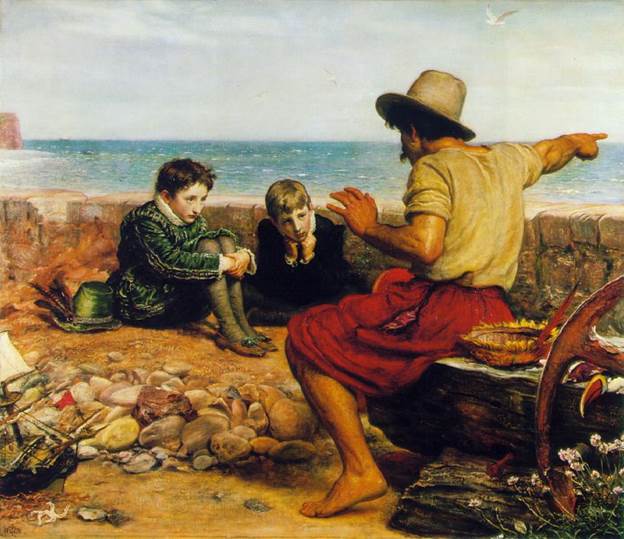
There was an old saying that experienced sailors (“Old Salts”) joined a new ship carrying “bag, box, and bird-cage.” Generally exotic birds they had picked up on some voyage to a distant, foreign land.[4]
Sailors also had many of really interesting stories to tell. Some of which may have been true. (Read a few pages of Camoens, “O Lusiads” some time.) Jim found Silver to be fascinating and likeable. Spent a lot of time in the galley.
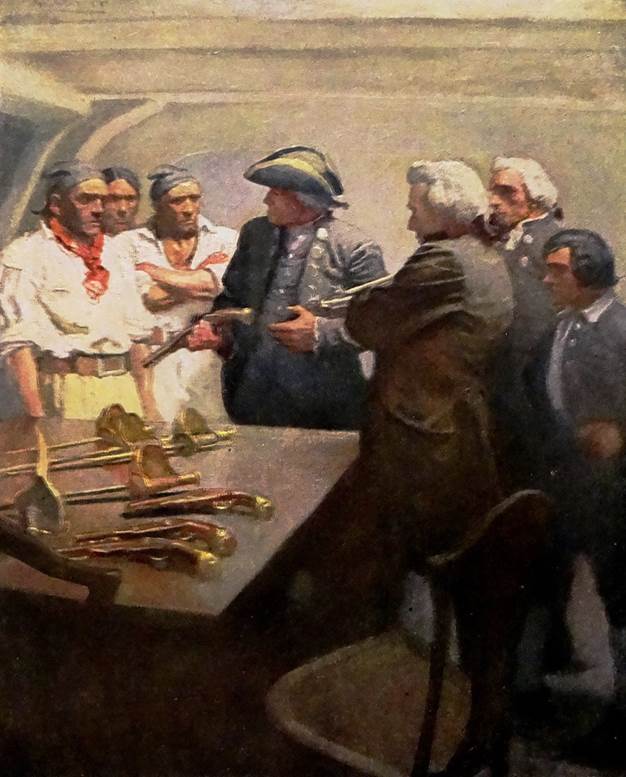
Most misfortunately, Silver is one of the pirates who had been hunting Billy Bones. Bones, in turn, had been their one-time captain. So are most other members of the crew. Their plan is discovered accidentally by Jim. They’re going to seize the ship, get the map, and go for the treasure out of which Billy Bones had cheated them. Jim narks on the plot, and the bougie treasure-hunters prepare to defend themselves from the prole treasure-hunters.
Lesson: Well, maybe sticking with your own kind is best after all.
Anyway, the story proceeds from there. If you know it, I don’t need to say more. If you don’t know it, then I don’t want to spoil the rest of it for you.
By way of Envoi: John Oxenham in a Devon tavern.
[1] That’s why hotels always get your credit card number as part of the reservation process. What if you’re sitting in the breakfast room in a hotel in Salt Lake City working through as big a plate of waffles, scrambled eggs, link sausages, tiny blueberry muffins—all of it covered in hot sauce, and several cups of coffee. Then some villainous-looking guy barges in wearing a MAGA hat and a “SL UT” tee-shirt? Starts heaping abuse on you about something, so you trying shoving his head into the waffle iron, then he runs away. So you go back to your room, but all the stuff you ate at breakfast is clogging the arteries, and you die right there. Big problem for the hotel, especially since the maids aren’t going to come around to put out clean, threadbare towels and slivers of soap until after you check out in a couple of days. What to do?
[2] This was before the government would stick in its oar and claim a share. You think I’m kidding? Look at the history of state lotteries. Horning in on the old numbers racket, then paying winners about two-thirds of what bookies used to pay.
[3] “’Til Bill Doolin met Bill Dalton//He was workin’ cheap, just bidin’ time//Then he laughed and said,”I’m goin,”// And so he left that peaceful life behind.”—Glenn Frey, Jackson Brown, Don Henley, J.D. Souther. What a team.
[4] Which is better than trying to keep a pet alligator on a ship. What if they get loose and make it to the bilge? Live off of rats for a while, get bigger, and start smelling the salt-horse in the food casks? Makes it risky for crewmen trying to heave up the rations out of the hold. Or bet on rat-fights in the cable tier, contrary to good order and discipline.
In the many days ago, young people–especially boys–didn’t like to read any more than they do today. People (parents, teachers, librarians, writers, and publishers) who wanted young people to grow up to be readers snapped up books that they thought kids would actually want to read. (Fortunately, this awful idea has now been rejected.)
In general, these people unquestioningly accepted traditional stereotypes about gender roles and characteristics. Boys were supposed to be adventurous, physically active, self-reliant, brave, and dirty. As a result, they glommed on to authors who wrote about adventurous boys and young-men in dramatic situations. They also sought to make these stories even more appealing by peppering the books with vivid illustrations. Basically, this strategy worked like a dream. The books engaged kids as life-long readers even after they had matured to the point where they didn’t want to be pirates anymore. Probably some of them didn’t entirely grow up and went out in search of adventure. It’s just my opinion, but I don’t see the harm in either one.
What is good and what is bad about these stories and illustrations?
First, many of these stories, and therefore many of the illustrations, were set in the past. From my selfish perspective, they’re great because they make people see the past (i.e. History) as really interesting dramas involving real human beings. This is way better than the kind of guff that appears in most school and college textbooks. “Bore the balls off a pool table,” as one colleague said.
Second, they make people want to read. Reading is essential to all higher-order thinking. It’s also the source of immense pleasure. This gives it the bulge on playing video-games.
On the other hand, these books were directed at white kids. They don’t show much interest in promoting tolerance for diversity or sensitivity to emotional distress. Nor are they concerned with contemporary urban problems and all the barriers to success raised up by society. They tend to take the more simple-minded position that Evil exists, that Courage is required to confront it, that Ambition is a good thing and that the Individual is responsible for his or her fate. So, they aren’t much in tune with modern opinion.
Still, they are interesting artifacts of a bygone time. As such, they can be examined for what messages they convey. What you find below is not great art. (Although, to be fair, Vincent Van Gogh said that Pyle’s pictures “struck me dumb with admiration.”) It is powerful illustration of books and magazine stories.
Howard Pyle (1853-1911) was born in Wilmington, taught at Drexel, and then set up his own art school in the Brandywine Valley. He became a popular illustrator of stories about historical subjects. His influence can still be felt. For example, no one knew how pirates actually dressed. Pyle made that up for his pictures. Hollywood costume designers then just borrowed the “Pyle look” when making movies about pirates. Compare some of Pyle’s pictures with Errol Flynn movies from the 1930s, or Captain Hook in the animated movies, or Johnny Depp’s “Jack Sparrow” and you will see what I mean.
Pyle’s greatest student was N.C. Wyeth (1882-1945). Wyeth was born in Massachusetts, but moved down to the Brandywine to study with Pyle. He never left. He’s the ancestor of all the other Wyeth artists whose work can be seen at the Brandywine River Art Museum. (NB: see my colleague’s comment above.)
Adolf Hitler’s view of Britain wavered between implacable foe and natural partner in a division of the world. In Mein Kampf (1925), he castigated Imperial Germany for pursuing a pointless fleet-building program that forced Britain into alliance with its traditional colonial enemies France and Russia. In the “Hossbach Memorandum” (1937) he described both France and Britain as “hate-filled” opponents who would never accept Germany’s revival. In 1934-1935 he still had hopes of winning over Britain, if only to disrupt the emerging Franco-British-Italian common front.
In November 1934, the Germans told the British that they wanted to reach a bilateral agreement that would allow the Germany navy to rise to 35 percent of the British navy.[1] The offer simultaneously attracted and disturbed the British. The Germans seemed bent on rearming in defiance of the Versailles Treaty in any case. The British most feared German bombing of cities. An agreement on navies could lead to an agreement on air forces. So, the German offer deserved consideration.
Several questions had to be resolved. First, could Britain tolerate ANY German naval rearmament? The Royal Navy had to be dispersed to meet its global responsibilities, while a German fleet would be concentrated in the North Sea and North Atlantic. Could Britain defend itself in Europe against a fleet one-third the size of the Royal Navy?
Second, would it be best to shape that rearmament to the kind of German fleet would be easiest to deal with? Would such a German fleet be symmetrical with the Royal Navy (in battle ships, cruisers, destroyers, submarines)? Or would it be a “lighter” fleet organized for attacking merchant shipping (lots of submarines and light cruisers, but few battleships)?
Third, British rearmament would prioritize the Royal Navy and the Royal Air Force, while German rearmament was already prioritizing the Army (Wehrmacht) and the Air Force (Luftwaffe). Both the British Army and the Germany Navy got the leftovers. Expert opinion held that the Germany Navy would not reach 35 percent of the present Royal Navy until 1942. By that time the Royal Navy would have been greatly expanded. The Germans would never really catch up. Seen from this perspective, a naval agreement might be a strategically meaningless concession while perhaps improving the climate of relations between the two countries. A more meaningful agreement on air forces might follow.
Fourth, the agreement could create diplomatic problems with the French. Britain and France were working up a common front with Italy to check further German violations of Versailles.[2] A bilateral agreement to end the naval disarmament conditions of the multi-lateral Versailles Treaty would be understood in France as both slimy and a betrayal.
Committees considered the issues. They concluded that a German fleet 35 percent the size of the Royal Navy marked the maximum that could be accepted, but it could be accepted. It would be best to insist upon a symmetrical fleet to short-stop one organized for a “guerre de course.” A naval agreement should be followed by pursuit of an agreement on air forces. Finally, “the French be damned” went unspoken, but not unthought.
[1] Joseph Maiolo, The Royal Navy and Nazi Germany, 1933–1939: Appeasement and the Origins of
Various “truths” emerged from the early histories of the origins of the First World War. Prominent among them: arms races lead to war, so—by implication–disarmament would lead to peace. The reasoning behind this “truth” ran something like the following. Military equality led to stability. Military inequality led to instability. Military inequality could emerge from either countries creating larger armies or from new technologies. Imbalances of either sort created a sense of insecurity on the weaker side and aggressive behavior on the stronger side. Building up one’s own power to restore stability became an entrenched response. Mutual fear and suspicion became entrenched, building up psychological tension. Linked to this idea of a spiral of power and fear, was a belief that the “Merchants of Death” (MOD) winding-up governments and publics in order to increase their profits. Corrupt politicians and journalists served the MOD as the agents of influence. After the war, disarmament became one chief purpose of diplomacy.
Therefore, naval armaments remained a live subject after the First World War. The Washington Naval Conference (1922) had agreed on a ratio of 5:5:3:1.75:1.75 in the number of battleships and battlecruisers between Britain, the United States, Japan, France, and Italy. The Geneva Naval Conference (1927) tried and failed to strike an agreement on the size and number of cruisers. The American and British concepts could not be reconciled.[1] The issues were revived, and this time agreed upon, in the London Naval Treaty (1930). The countries compromised on different classes of cruisers, while also limiting submarines and destroyers.[2]
Germany participated in none of these conferences because its navy had been severely limited by the Versailles Treaty. The Versailles Treaty did allow Germany to replace existing ships once they were at least 20 years old. The oldest of its battleships had been built in 1902, so by the mid-Twenties, Germany designed a new type of ship, the “Panzerkreuzer” (or “pocket battleship”). When the wartime Allies learned of these ships, they tried to prevent their construction. Germany offered to not build the ships in exchange for admission to the Washington naval treaty with a limit of 125,000 tons. The Americans and British were willing to appease German demands, but the French refused.
Meanwhile, Germany argued that either all countries should disarm or Germany should be allowed to rearm to the level of other countries. The League of Nations and many right-thinking people took this argument at face value, so it sponsored a World Disarmament Conference (1932-1933).
Mid-stream, Hitler came to power, abandoned the Disarmament Conference (October 1933), and announced that Germany would rearm in defiance of the Versailles Treaty. On the one hand, this tipped Britan toward a policy of gradual rearmament (1935-1939).[3] On the other hand, it led to the creation of the Stresa Agreement (14 April 1935) between Britain, France, and Italy to resist future German violations of Versailles. Could the “allies” maintain solidarity? Yet no British leader wanted war. Could Germany be either deterred or appeased?
[1] The British wanted more light cruisers for protecting imperial trade routes, the Americans wanted fewer, but heavier cruisers. The Japanese wanted a ratio of 70 percent of the American fleet, not the same 5:5:3 ratio of 1922.
[2] One effect of the naval treaties combined with the Great Depression appeared in the collapse of the British shipbuilding industry. Beating arms into breadlines, so to speak.


 Billy Bones, retired pirate captain. Not in very comfortable circumstances by the look of it: rum scars on his nose; raggedly sewn-up scar on his right cheek (probably didn’t do that shaving); right sleeve of his coat is burst at the shoulder and out at the elbow; wrapped up in an old boat-cloak. He awaits the retribution for his acts and it isn’t coming from the Crown Prosecution Service either. He’s standing on a cliff where he can watch the sea, he’s got his brass spy-glass, and the scabbard of his cutlass is visible. Still, there’s much determination and no fear in that face.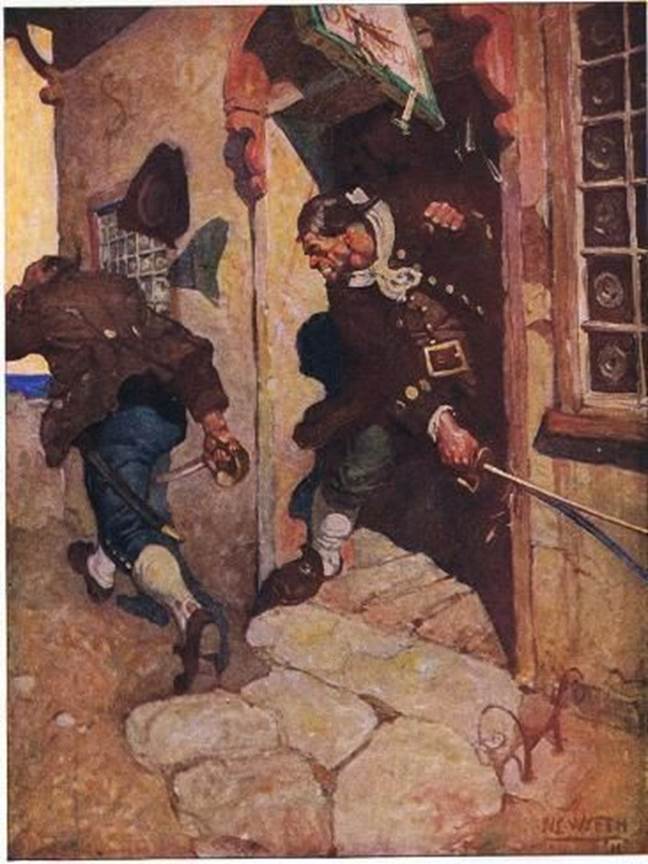




 waroftheworldblog
