

Lesson: A century before, a Royalist historian described Oliver Cromwell as “that brave, bad man.” One thing that makes History so much fun to read and so awful to live through is that there’s a bunch of these people in any given population. “Fight! Fight! Fight!” as someone said.
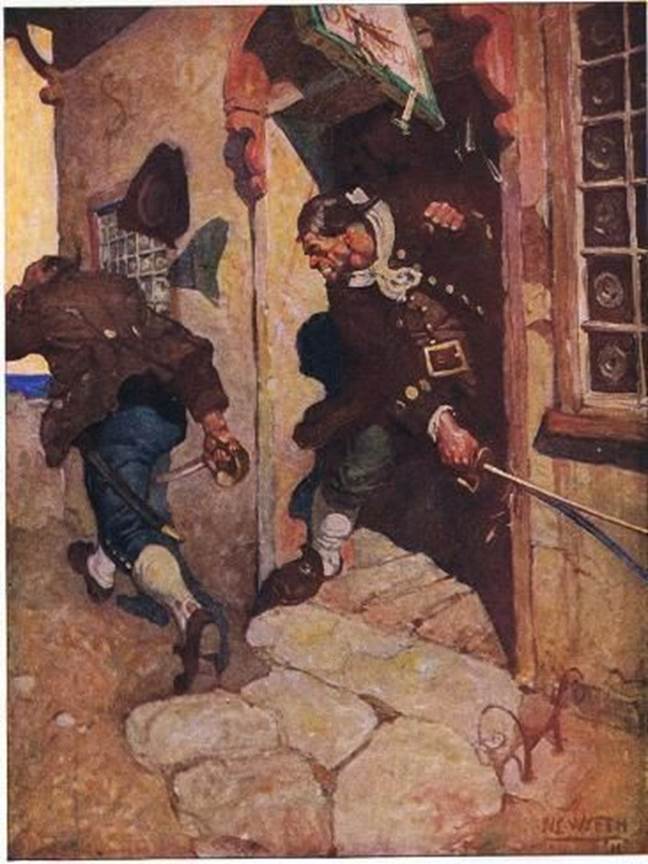
Billy Bones has been “tipped the black spot” in the tavern of the “Admiral Benbow Inn,” home to young Jim Hawkins and his widowed mother. The guy running away had tracked down Billy Bones and given him a piece of paper with a spot of black ink on it. In the many days ago, it meant a death sentence. Billy replied in more immediate terms. Giclee Print: Captain Bones Routs Black Dog: One Last Tremulous Cut Would Have Split Him Had it Not Been Intercep by Newell Convers Wyeth : 12x9in
Lesson:

“Old Blind Pew.” Retribution in human form. Got whacked on the head by a falling yard arm in a fight at sea or caught a load of gravel in the face pushed up by ricocheting round-shot in a fight ashore. (The latter is what took off young Horatio Nelson’s arm.) Now with a black silk scarf around his head to cover his ruined eyes; tap, tap, tapping along the road. He’s been abandoned by his fellow evil doers before the posse can arrive. 3:10 to Yuma (2007) – I hate posses
After the quarrel in the tavern, Billy had a stroke and died. Awkwardly, he had not paid his bill.[1] Anyway, Jim’s mother is determined to collect what is owed her, in spite of the danger that the pirates will return to kill Billy Bones. So, they open his sea chest. There’s money, but most of it isn’t British and Mrs. Hawkins, worthy soul though she is, isn’t a foreign exchange trader. Eventually—it’s getting dark and Jim is offering wise counsel—she settles for grabbing an oil-skin-wrapped packet. They bolt out one door while the pirates approach another door.
Lesson: “There’s no honor among thieves.”
In the background stands “The Admiral Benbow Inn.”
The oil-skin packet turns out to contain a treasure map. A bunch of the respectable local notables are consulted; they see a chance to become “rich as Nazis”—as Mr. Burns once put it; and they throw in together. They hire ship and a captain, get a crew; take Jim along because it’s his map; and set sail for wealth and adventure.[2]

Jim Hawkins leaves home. He’s dressed in plain brown clothes; he has his few possessions tied up in a red and white polka dot bandana that is tied to a stick. His mother has already lost her husband and now her son is departing. She lifts her apron to her face. Young Jim looks neither excited nor regretful. I see determination. He’s already turned his back on the inn and on his mother and on his past. He’s now looking toward the road that will take him away.[3]
Then, there was a long-held belief that the inner person was expressed in the outer form. The great Soviet movie director Serge Eisenstein believed this. It guided all his casting decisions. (Look at the officers on the “Battleship Potemkin.” Battleship Potemkin (1925) – Meat Scene – High Quality – With English Subtitle ) Compare Jim’s face with that of Billy Bones or Pew. The faces of the pirates are less-than-human/animalistic; full of strength, anger, and ruthlessness.
Jim Hawkins Leaves Home by N. C. Wyeth. “Treasure Island” … | Flickr

In the galley of the ship. The hired captain had hired a crew. One was the sea-cook, called “Long John Silver.” “Long” means he was tall. He’s got only one leg. “Oh, poor man! In such a heartless time in History!” Well, not exactly. “Right man-o-wars-men” (hands in the Royal Navy) who lost a leg in battle couldn’t go climbing up the rigging anymore. So, they often got trained as cooks. All Silver’s one-leg means is that he got badly wounded in a sea-fight.
There was an old saying that experienced sailors (“Old Salts”) joined a new ship carrying “bag, box, and bird-cage.” Generally exotic birds they had picked up on some voyage to a distant, foreign land.[4]
Sailors also had many of really interesting stories to tell. Some of which may have been true. (Read a few pages of Camoens, “O Lusiads” some time.) Jim found Silver to be fascinating and likeable. Spent a lot of time in the galley.
Long John Silver and Hawkins by N. C. Wyeth. “Treasure Isl… | Flickr
Lesson: Your “own kind” aren’t the only people worth knowing.
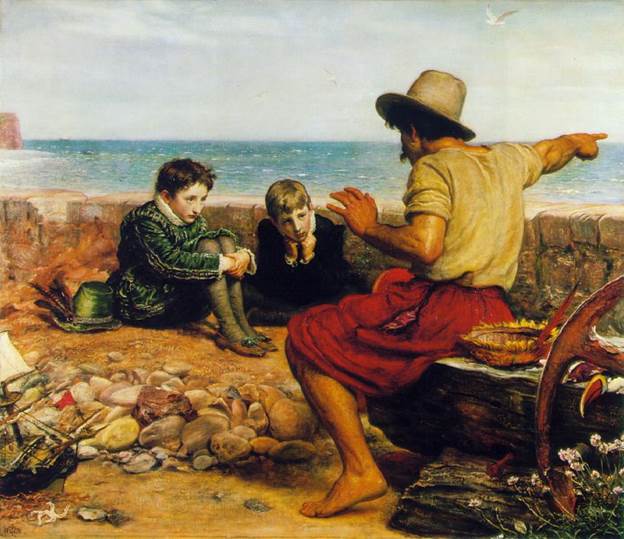
Young Francis Drake listening to an old sailor’s stories down in the West Country.
Sir Francis Drake – Uncyclopedia
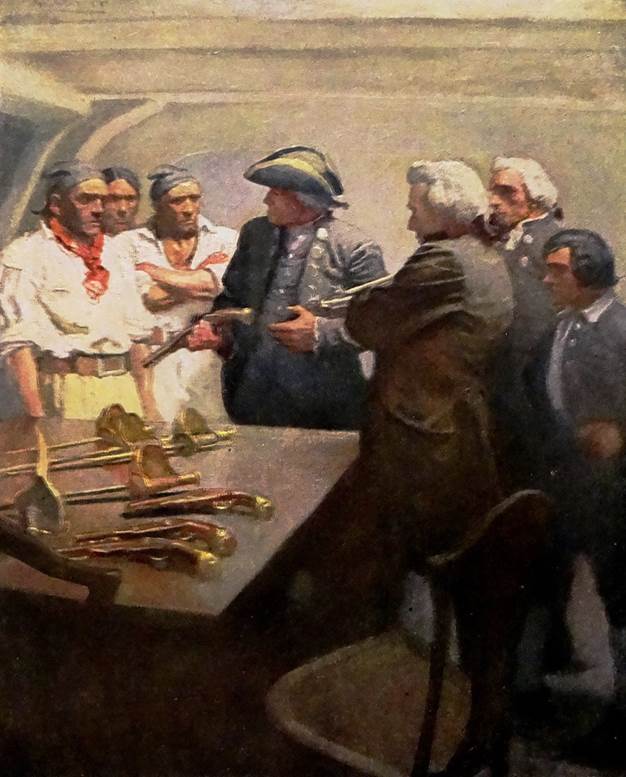
Most misfortunately, Silver is one of the pirates who had been hunting Billy Bones. Bones, in turn, had been their one-time captain. So are most other members of the crew. Their plan is discovered accidentally by Jim. They’re going to seize the ship, get the map, and go for the treasure out of which Billy Bones had cheated them. Jim narks on the plot, and the bougie treasure-hunters prepare to defend themselves from the prole treasure-hunters.
Lesson: Well, maybe sticking with your own kind is best after all.
Anyway, the story proceeds from there. If you know it, I don’t need to say more. If you don’t know it, then I don’t want to spoil the rest of it for you.
By way of Envoi: John Oxenham in a Devon tavern.

[1] That’s why hotels always get your credit card number as part of the reservation process. What if you’re sitting in the breakfast room in a hotel in Salt Lake City working through as big a plate of waffles, scrambled eggs, link sausages, tiny blueberry muffins—all of it covered in hot sauce, and several cups of coffee. Then some villainous-looking guy barges in wearing a MAGA hat and a “SL UT” tee-shirt? Starts heaping abuse on you about something, so you trying shoving his head into the waffle iron, then he runs away. So you go back to your room, but all the stuff you ate at breakfast is clogging the arteries, and you die right there. Big problem for the hotel, especially since the maids aren’t going to come around to put out clean, threadbare towels and slivers of soap until after you check out in a couple of days. What to do?
[2] This was before the government would stick in its oar and claim a share. You think I’m kidding? Look at the history of state lotteries. Horning in on the old numbers racket, then paying winners about two-thirds of what bookies used to pay.
[3] “’Til Bill Doolin met Bill Dalton//He was workin’ cheap, just bidin’ time//Then he laughed and said,”I’m goin,”//
And so he left that peaceful life behind.”—Glenn Frey, Jackson Brown, Don Henley, J.D. Souther. What a team.
[4] Which is better than trying to keep a pet alligator on a ship. What if they get loose and make it to the bilge? Live off of rats for a while, get bigger, and start smelling the salt-horse in the food casks? Makes it risky for crewmen trying to heave up the rations out of the hold. Or bet on rat-fights in the cable tier, contrary to good order and discipline.
 waroftheworldblog
