Solar Power Rises in the East.

            Once, America was the greatest industrial economy in the world, while China was a monument to Communist fanaticism.  Today, 28 percent of China’s economy is devoted to manufacturing, while 11 percent of America’s economy is devoted to manufacturing.  Much attention and criticism has focused on the “unfair” means by which China has risen up to become the workshop of the world.  China has used massive government subsidies, intellectual property theft, and exchange rate manipulation to achieve this goal.  The social and political effects of American industrial decline have polarized the country.  What may be missing is a recognition of an equally great source of China’s real “Great Leap forward”: educational priorities.[1] 

            Between 2000 and 2024, enrollment in China’s higher-education system has risen ten-fold.  That means that between 1976 and 2000, enrollment in Chinese secondary education also rose by at least this much.  That means that forty years ago, the Chinese government made a commitment to dramatically improving the educational qualifications of the country’s people. 

It wasn’t just more students going to university, then to graduate school.  As a share of the student population, many more Chinese students major in science, math, and engineering than is the case in most large economies of the world.  More than 50 percent of Chinese undergraduates and 75 percent of graduate students major in math, science, engineering, or agriculture.  In comparison, 20 percent of American undergraduates and 50 percent of graduate students major in these areas.  That means that forty years ago, the Chinese government saw science and technology as the keys to future power and prosperity. 

            They may be just getting started.  Since 2014, China has tripled its spending on research and development.[2]  The July 2024 meeting of the country’s leaders opted to “make extraordinary arrangements for urgently needed disciplines and majors” over the next decade.    

            Look at the specific case of batteries.  Huge amounts of readily available and cheap raw materials can be used to make powerful and long-lasting rechargeable batteries.  These can be used to power electric vehicles.  The Chinese have figured out how to do this.  No surprise here: there are almost 50 graduate programs in China where faculty and students focus on battery chemistry or battery metallurgy.  In the United States, there is “a handful” of individual professors.  One result is that two-thirds of scientific papers on these subjects now come from China.  American scientists produce 12 percent. 

What course for other industrial countries?  One solution is to do what China began to do half a century ago, get the foreigners to build factories in your country so that you can share in the Chinese success.  Another solution is to learn to do what the foreigners already know how to do by copying what they have done. 

Does the current tariff war against China contemplate possible “peace settlements”?  Building products in America has long been a strategy for Japanese and European car companies.  Building a science and technology infrastructure prioritizing involving labs and scientists, and sustained across half a century may be problematic for a political system and culture like those in the United States. 


[1] Keith Bradsher, “How China Built Its Tech Prowess: STEM Classes and Research Labs,” NYT, 14 August 2024. 

[2] China devotes 2.6 percent of GDP to research and development; the United States 3.4 percent.  So, 0.9 percent in 2014. 

Deficit Scold.

            There are big, important things.  Often they are dull.  There are small, unimportant things.  Often, they grab the headlines.  The big, important things are both “global” (the health of the world economy, climate change, global demography) and “parochial” (the economic situation of the United States, the state of American “hard” power, the current political polarization).  The “big” things are worth thinking about, the “small” things not. 

            One “big” thing is the government deficits and national debt.  Earlier in 2024, the Congressional Budget Office (CBO) projected a 2024 U.S. government budget deficit of $1.6 trillion; in mid-June 2024, it revised that to $1.9 trillion.[1]  Even this is probably over-optimistic.  It includes an assumption that the tax cuts passed in 2017 during the first Trump administration will be allowed to expire in the near future.  Politically, this is a very unreasonable assumption.  President Joe Biden has said that he would extend at least some of the tax cuts and Presidential-candidate Kamala Harris is currently expected to model her basic economic policy on that of the Biden administration.  For his part, Donald Trump has pledged to extend all of the tax cuts.  Fully extending the tax cuts would reduce revenue by $5 trillion over ten years. 

The fundamental problem is an imbalance between spending and revenue.  In recent decades, this has led to large annual deficits.  The deficits have been covered by borrowing.[2]    

What are the sources of these deficits?  First of all, a large aging population has started relying on Social Security and Medicare/Medicaid.[3]  Second, borrowing money requires paying interest.  Even at low interest rates, a quantitatively expanding debt will increase the amount of interest that has to be paid.  The CBO estimates that interest payments will rise from $892 billion in 2024 to $1.7 trillion in 2034.  Higher interest rates, used to control inflation, compound this effect.  At the same time, the United States has spent forty years cutting taxes. 

The national debt of the United States—all the accumulated deficits—stood at about $20 trillion in early 2017.  By mid-2024, it had increased to $35 trillion.[4]  One budget expert judges that “the overall fiscal and economic environment is a lot worse” than before Trump and Biden occupied the White House.[5]  The CBO has recently projected that the U.S. national debt—all the accumulated deficits–would reach or surpass $56 trillion by 2034.  In 1999, the national debt amounted to 99 percent of Gross Domestic Product (GDP); in 2034, it projects that the debt will be 122 percent of GDP.  “[T]he country’s fiscal backdrop is increasingly grim.”[6] 


[1] The Biden administration blames the Republican tax cuts for the deficits and debt.  However, the jump from $1.6 trillion to $1.9 trillion sprang largely from the Biden administration’s cancellation of student debt, from the military aid provided to Ukraine and Israel, and from unexpectedly large payments for Medicaid. 

[2] That is, for decades now, Americans have wanted a bunch of stuff, but they haven’t wanted to pay for it.  Instead of doing without any of the things that they wanted, they borrowed the money in return for I.O.U.s in the form of Treasury bonds.  An I.O.U. is a promise to pay in the future.  It has been a long-running complaint among what the great economist Paul Krugman calls “deficit scolds” that “we are leaving our children a mountain of debt.”  That is true only if our children are willing to pay it.  Such a willingness assumes that they are made of sterner stuff than their predecessors. 

[3] The “Baby Boom,” born 1946-1963, retires between 2011 and 2030.  Obviously, this problem will end one day. 

[4] Just over half of the post-2017 increase of $15 trillion took place during the Trump administration ($7.8 t); just under half took place during the Biden administration so far ($7.3 t). 

[5] Jim Tankersley, “Trump Tax Plan Could Add Debt by the Trillions,” NYT, 10 August 2024. 

[6] Alan Rappeport, “U.S. Debt Set to Top $56 Trillion,” NYT, 19 June 2024. 

Fact Check 5.

            J.D. Vance has criticized Tim Walz as “the guy who let rioters burn down Minneapolis” in May 2020.  The New York Times “Fact Check” says that “this is exaggerated….claims that he did not respond at all, or that the city burned down, are hyperbolic.”[1]  Hyperbole is the common coin of American politics.  People know what you mean.  What were the facts? 

            On 25 May 2020, several Minneapolis police officers participated in the murder of George Floyd.  The killing aroused public opinion in the Minneapolis area.  From 26 through 30 May 2020, the area witnessed much civil unrest.  Demonstrations quickly turned to rioting, looting, and arson.[2] 

Minneapolis mayor Jacob Frey asked Governor Tim Walz for 600 National Guard troops on the evening of 27 May 2020.  One text from a Frey aide said that Walz was “hesitating.”  Walz didn’t approve the request until 4:00 PM on 28 May. 

            How much time was lost?  The initial request came at or before 8:00 PM on 27 May, two hours after the day’s looting and rioting had begun.  Walz waited until 4:00 PM on 28 May to approve the request.  That’s a 20-hour delay.  Even then, he ordered in 500 guardsmen.  Early on the morning of 29 May the first National Guard elements were on the streets of Minneapolis.  That was 12-14 hours after Walz had granted his approval. 

What if Walz had granted Frey’s original request made at 8:00 PM on 27 May?  Then the first National Guard troops could have been on the street by 8:00 to 10:00 AM on 28 May.  Most of the daylight hours were peaceful.  Night brought the burning of the Third Precinct police building and much destruction in St. Paul.  Not until 30 May did Walz order a large mobilization of National Guard troops, eventually totaling over 7,000.

Why did Walz hesitate?  Walz has said that he didn’t believe that Frey “knew what he was asking for”; nor did the mayor tell Walz how many troops he wanted, or what he wanted them to do, or what capabilities they should possess.  Why would Frey be able to tell him these things?  He was a 39-year old former city council-man become a first-term mayor.  He had never actually run anything before, let alone had to deal with a riot.  He really needed someone to step in and take the lead.  Walz might have recognized that.  Walz might have called Frey early to offer National Guard troops, not wait for a request, then let it get bogged down in process issues. 

But what is true of Jacob Frey is also true of Tim Walz in May 2020.  He had run a classroom, a high school football team, and some study-abroad trips.  He had been an enlisted man in the Army National Guard, rising to the rank of Command Sergeant Major.  According to a story in the New York Times, his Guard unit served on missions like “flood cleanup and recoveries from forest fires and tornadoes.”  Walz implemented orders from superior officers.  His commanding officer has praised him as “a good soldier” who was “energetic,” “dependable,” and “willing to do whatever we asked him to do.”[3]  He had been a Congressman for ten years, cozening executive branch officials on behalf of his constituents and taking positions on issues.  Walz became Governor on 17 January 2019.  He had even less time in office than did Frey.  Like Frey, he had never run anything so big or faced a real crisis.  It should come as no surprise that he did some things wrong.  The real question is what did he learn from the experience? 


[1] Linda Qiu, “How Republican Claims About Walz’s Record Stand Up to Scrutiny,” NYT, 11 August 2024. 

[2] See: George Floyd protests in Minneapolis–Saint Paul – Wikipedia 

[3] Thomas Gibbons-Neff, John Ismay, and Kate Selig, “Walz Ended His 24-Year Military Career With a Hard Decision,” NYT, 13 August 2024. 

High Modernism.

            “Modernity” is an umbrella term for the period from about 1500 to the recent Present.  Under the umbrella are found the ideas and institutions of science, capitalism, and the nation-state, along with their sub-units and opponents.  If a single idea is associated with Modernity it is Progress. 

            “High Modernity” is the shared absolute confidence in the expertise of those possessing much intellectual capital.  While engineers and bureaucrats possess valuable expertise, at the core of High Modernism stands a reverence for science,[1] scientific knowledge, and (implicitly) in scientists.[2]  These offer the sole credible way of understanding the world.  Together, technology, government, and academia provide the levers with which Science can improve the natural and social worlds.  Historians have labeled the political expression of these beliefs as “the “Responsive National State” and the “Project State.”[3]

High Modernism is not explicitly anti-democratic.  The reverse of the pro-expertise medal is a disregard for the contexts (historical, social, and geographical) in which improving change is intended to occur.[4]  Ordinary people are liable to resist the unfamiliar.  Therefore, government by strong authority systems offer a common way of implementing reform.  By its very nature, High Modernism is “elitist” and anti-populist. 

James Scott, who died recently, left an immense scholarly foot-print on these issues.  In one key book, he analyzed “how certain scheme for the improvement of the human condition have failed.”[5]  His case list is eclectic.  It includes the Soviet collectivization of agriculture in the 1930s; the construction of the new capital of Brasilia within the context of Brazilian economic development in the 1950s; and the forced “villagization” program in Tanzania in the 1970s. 

All such schemes were changes imposed on unwilling common people from above.  All of them made the subjects miserable, if they didn’t kill them in droves.  All of them failed to achieve their goals.  They failed, in part, from life’s complexity exceeded expert plans. 

What of the non-elite majority who are to be helped, reformed, improved, modernized by experts?  The question arose in what academic scholars have called “subaltern studies,” basically the study of the subjects of foreign empires.  In the eyes of foreign rulers, these people have a voice only to the degree that they assimilate to the culture of the foreign ruler, accept the assumptions of their overlords.[6]  There is a reciprocal nature to such reform-from-above.  The reformers either expect resistance or encounter resistance.  They push through with more assertive means, justified as expert opinion and deriding the opposition as irrational.  Resistance continues.  Why can’t the same analysis be applied to the citizens of advanced nations? 


[1] Now grudgingly understood to include the “Social Sciences” (economics, sociology, psychology, political science) to the extent that they employ quantification and modeling. 

[2] We’ve been here before.  See Carl L. Becker, The Heavenly City of the Eighteenth-Century Philosophers (1932). 

[3] On the former, see John  P. McKay’s contribution to John P. McKay, Bennett D. Hill, and John Buckler, A History of Western Society, vol. II,  pp. 809-817; and Charles S. Maier, The Project-State and Its Rivals: A New History of the Twentieth and Twenty-First Centuries (2024). 

[4] This, the knowledge provided through the Humanities. 

[5] James C. Scott, Seeing Like a State: How Certain Schemes to Improve the Human Condition Have Failed (1985). 

[6] There is a tedious explanation of all this at Subaltern (postcolonialism) – Wikipedia 

A Historical Episode of Debt Repudiation.

            Over the course of the 18th Century, the kingdom of France got into serious financial trouble.  Over-simplified, both sides of the balance sheet were out of order.  The government spent too much money on administration, lost wars, and a lavish royal court.  The government took in too little money because the aristocracy and the Church paid too little in the way of taxes in proportion to their vast share of the productive resources of the country. 

In 1788, King Louis XVI had to face the fact that France was broke and needed to call an Estates-General to raise revenue.  The government spawned by the Estates-General sought to deal with France’s financial problems by confiscating the lands of the Church and of aristocrats who had fled abroad, and issuing a paper currency (the “assignats”) backed by the revenue expected to come from the sale of those lands.  Printing paper “assignats” offered a simple solution to the revolutionary government’s budget problems.  This became all the more true when war with a host of other countries broke out.  Inflation mounted rapidly, while efforts to control prices by mandate failed. 

Inflation penalizes those who cannot adjust their incomes.  It is tolerable to those who can adjust their incomes in pace with the rising prices.  It rewards those who can over-adjust their incomes.  How?  Borrow money or buy on credit for future repayment.  Over time, you can repay the original debt with depreciated currency.  Generally, inflation hammers ordinary people while rewarding the enterprising—or the dishonest. 

In 1794, the Finance Minister reported that “The national Treasury was completely empty; not a single sou (penny) remained. The assignats were almost worthless; the little value which remained drained away each day with accelerated speed. One could not print enough money in one night to meet the most pressing needs of the next day…. The public revenues were nonexistent; citizens had lost the habit of paying taxes. […] All public credit was dead and all confidence lost. […] The depreciation of the assignats, the frightening speed of the fall, reduced the salary of all public employees and functionaries to a value which was purely nominal.”  Even when the government finally stopped printing paper currency—and publicly destroyed the printing presses, all the previously-issued paper currency remained in circulation. 

Furthermore, there remained the national debt in the form of bonds sold by the government to people with money to spare.  The process for raising money was normal.  The amount of money raised was not. 

This went on until 1797.  On 30 September 1797, the Finance Minister of the time, Dominique-Vincent Ramel acted to stop this process.  On the one hand, he imposed a series of new taxes on property and luxury goods.  The property taxes took the form of levy based on the number of fireplaces and chimneys, and doors and windows in a building.  To deal with the national debt, Ramel called in all the outstanding bonds, then replaced them with new bonds at one-third of the value of the old bonds.  That is, the government repudiated two-thirds of the national debt.  Those who had bought bonds out of prudence or patriotism lost two-thirds of their investment. 

This is a matter of purely historical interest.[1]            


[1] Alan Rappeport, “U.S. Debt Set to Top $56 Trillion,” NYT, 19 June 2024. 

Ukraine and Russia fighting for peace.

            Vladimir Putin seems to have done some of his homework before attacking Ukraine.[1]  While the military plan of conquest failed badly, his diplomatic preparations have proved much more sound.  He played on the discontent among revisionist states with the American-led “rules based order.”  In particular, Putin formed an explicit partnership with China’s Xi Jinping before launching his attack.  Since then, China has remained formally “neutral on the side of Russia.”[2]  Western economic sanctions plastered on Russia have been blunted by China’s purchases of Russian oil and gas, and by China’s sales of consumer goods.  China has also provided Russia with “dual-use” (i.e civilian and military) technology. 

An authoritarian Russia is backed by other anti-Western dictatorships (China, Iran, North Korea); a democratic Ukraine is backed by the North Atlantic Treaty Organization (NATO).   The objective balance of forces favors Russia.  The uncertainty introduced by the 2024 American presidential election compounds Ukraine’s sense of insecurity.  What would the election of Donald Trump mean for American support for Ukraine?  What would the election of Kamala Harris mean for American support for Ukraine?  Neither one is Joe Biden; each would be free to pursue their own priorities in foreign policy. 

Russia’s conditions for even a cease-fire amount to a surrender by Ukraine and NATO.  Ukraine would have to agree to permanently halt its current drive for NATO membership; agree to become permanently neutral, and pull its troops out of areas of the Ukraine where they have been fighting the Russian.  In addition, international economic sanctions on Russia would have to be lifted. 

Now, beleaguered Ukraine is willing to negotiate an end to its war with Russia on “just terms.”  Ukraine’s conditions for a cease-fire amount to a surrender by Russia.  Chief among them is the demand for Russia has to pull its troops out of all Ukrainian territory and leave them under Ukrainian control.  Ukraine’s President, Volodymyr Zelensky launched an effort to gather other countries to pressure Moscow to make peace on Ukraine’s terms.  That effort has failed, and Zelensky has publicly blamed China.  Zelensky has argued that China urged other countries to not attend. 

            China does not seem disturbed by the criticism.  China uses a different terminology from the West, calling the conflict a “crisis” rather than a “war.”  It has called for a cease-fire.  In May 2024, China and Brazil issued a proposal for peace.  Xi Jinping has said that a real peace conference has to include Russia as an equal.  Xi did not attend the conference organized by Ukraine, which excluded Russia.  “China believes that all conflicts must be resolved by returning to the negotiating table,” said China’s foreign minister Wang Yi. 

            Some people believe that any further developments will have to wait on the American election in November 2024.  This is not true.  There is a lot of time left in the fighting season for Russia to act.  Why not present whoever wins the election with a new military situation that forces either Trump or Harris to make the same decision on Ukraine? 


[1] Isabel Coles and Austin Ramzy, “China Casts Itself as Peacemaker,” WSJ, 25 July 2024. 

[2] Similarly, the Soviet Union was “neutral on the side of Germany” from August 1939 to June 1941; the United States was “neutral on the side of Britain” from May 1940 to December 1941.  The neutrals supplied their partners with arms, food stuffs, and raw materials, while making life as difficult as possible for the enemy of their partner. 

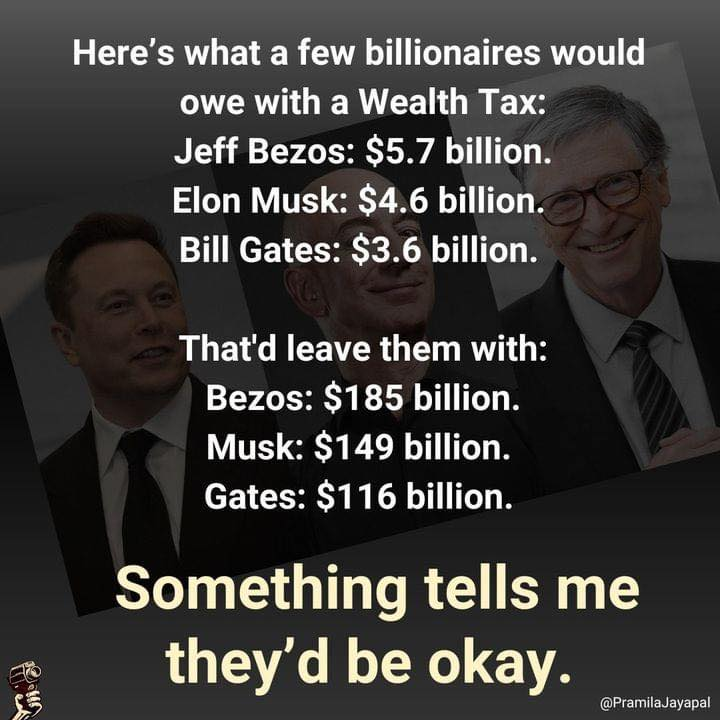
Occupy the Other 98 Percent 2.

Comment:

            Original quote by Congresswoman Pramila Jayapal (D-Washington). 

In 2022, the US government deficit–not the national debt, which is vastly greater–was $1.2 trillion.

Seizing ALL the wealth of these three men would produce $454 billion. That would cover one-third of one year’s deficit.

Then, you could never go back to that well in following years because you would already have seized the wealth that generates their income.  That income allowed them to accumulate such wealth.

IF you get your wish and seize their wealth, THEN you have to choose what to do with it.

Sell it for revenue? Then other rich people will be the buyers of these goods at fire sale prices. You’ll just make other rich people richer.

OR the US government could operate these corporations to derive the income that now goes to the men who actually created those businesses. Maybe you could have the Post Office run Amazon and NASA run SpaceX?  Should turn a tidy profit from that. 

Final thing, the Constitution granted the government revenue from tariffs and excise taxes. The Constitution had to be amended to allow an INCOME tax.[1] For a WEALTH tax, the Constitution would again have to be amended.

“Occupy Democrats” doesn’t seem to care about any of these facts.  On “Occupy Democrats,” see: Occupy Democrats – Wikipedia 


[1] See: Sixteenth Amendment to the United States Constitution – Wikipedia  On the issues involved in a “wealth tax,” the following is helpful.  Is A Wealth Tax Constitutional? : Planet Money : NPR 

Occupy the Other 98 Percent 1.

Comment:

His birth-name is Bowman, but his mother divorced his father soon afterward.  So he did not “grow up” under that name.

His mother remarried and her new husband, named Hamel, adopted the boy and changed his name to Hamel.  Didn’t ask the kid what he wanted.  

“Jimmy” is a common form of “James.” 

He grew up in Middletown (not Middleton), Ohio, which is dominated by a steel mill that had to shed a lot of workers. IDK what kind of suburb you live in, but I bet there isn’t a rolling mill as the main employer.

Upon graduation from high school, he enlisted in the Marines. Assigned to be a military correspondent, he deployed to Iraq in 2005 and was assigned as a PIO for a Marine air unit. He has said that the Marines “taught me how to live as an adult.” If you read a bunch of memoirs-disguised-as-war-novels (like Herman Wouk, The Caine Mutiny; Nicholas Monsarrat, The Cruel Sea; Leon Uris, Battle Cry), you’ll see that this is a common recognition.  Also, Vance says that he never saw any real combat.  So, no stolen valor here. 

Went to Ohio State on the G.I. Bill.  Went to Yale law school on a near-full ride scholarship. So much for the “‘not poor at all” lie.

His mom’s maiden name is Vance. Yes, when he got married, he took her last name, rather than that of one of the men passing through her troubled life in one of the places that urban, hi-tech and high finance America forgot for so many years.   

What’s a “hillbilly”?  According to Merriam-Webster, it’s a “person from a backwoods area.”  Vance’s mother grew up in Jackson, Kentucky.  Population 1,852 in 1960.  After she moved to Ohio, J.D. Vance spent some summers in Jackson.  We have Saint Patrick’s Day for all who claim Irish ancestry, no matter how remote, but Vance’s claim to cracker roots is a “literary fiction”? 

This was created by a site with a long record of producing distorted material in support of the Democratic party. Fine; it’s a free country. Or so they say.

However, it isn’t hard to check the supposed “facts.”  Anymore than it is for Trump supporters to check the facts on the equivalent garbage churned out by equivalent sites on the right. If facts are what you want to know. 

The Middle Kingdom Commission on Higher Education.

            It can be difficult to conduct normal academic research in contemporary China.  The country is a Communist dictatorship, even more so under Xi Jinping than under his immediate predecessors.  Information is tightly controlled.  The rising tensions with the West, and especially with the United States, make people both suspicious of and suspect from close contact with Westerners. 

            As a result, much of the most insightful work relies upon personal experience or interviews with a few people willing to talk in some depth about their own experiences.[1]  Such personal experience and observation can cast light upon larger institutions.  Thus, two recent books agree that China’s educational system remains as it was in the 1990s: “competitive, repetitive, [and] test-focused,” requiring “intense powers of focus…to succeed.”  The exams begin early in elementary school and continue through high school.  Then there are the exams for college admission.  All the exams open—or close—the paths to success in many areas.  Parents worry that their children will fall by the wayside.  Often, they pay for supplemental instruction, either in-person or on-line to buff up their children’s chances of success.  That makes for long hours of hard work for both parents (to earn the money for the courses) and the children (who grind through the lessons).[2]  Failure traditionally means a life of blue-collar industrial work.  Sewing pants and shirts in a sweat-shop for the American market, for example. 

            Is such a system “good” for Chinese society in general and for the students themselves in particular?  Well, it gives China a lot of highly qualified human capital in whatever areas the government values.  If it is engineers, scientists, and economists, then it serves the needs of a society in the course of economic development.  China’s economic performance over the last half century has been remarkable.  People who perform poorly on the exams provide some of the less-skilled labor to man the factories. 

            It is more of an open question about how well the system fills the needs of the students.  Part of the difficulty in assessment is that most American students don’t work as do elite Chinese students.  So it is natural to respond “Yikes!”  Then, American education isn’t very well attuned to the “needs of society” being more important than the desires of students.  That isn’t the same thing as students not being well attuned.  They generally want good jobs and are alert to signals from the market.  Hence, there are a lot of business majors and nurses in training.  The colleges and universities fall into line in the desperate struggle to stay afloat and avoid being yelled at by parents, donors, and Senators grabbing a sound-bite.  Yet the United States seems to fall behind at producing engineers and scientists, while over-producing lawyers. 

            Education is one area in which Communist Party control remains clear.  There is always the possibility that rigid institutions will generate resentment and resistance.  Keeping the lid on works.  Until the temperature inside rises enough to cause a boiling over. 


[1] See Maura Elizabeth Cunningham, “China’s Education Grind,” WSJ, 13-14 July 2024.  Cunningham reviews Peter Hessler, Other Rivers, and Yuan Yang, Private Revolutions. 

[2] Many recent immigrants from the Far East to the United States, mostly Chinese and Vietnamese, pursue the same strategy in their new country.  The success rate of such Asian-American students in gaining admission to the selective, exam-based elite high schools in New York City has spawned an ugly backlash.  Parent-of-Other-Color complain about the small numbers of Black and Hispanic students who win admission. 

The Rap on Kamala Harris.

            Critics of Kamala Harris (and they’re not all Republicans) cite the following perceived weaknesses.[1] 

            Regardless of what the Democratic “pezzonovante” think about Harris, voters don’t like her.  When she ran for Attorney General of California, she beat her Republican opponent by less than a percentage point.  All other Democrats in state-wide races won by at least 10 points.  In the 2020 presidential primaries, she flashed briefly, then had to drop out before the first primary.  As Vice President, she hasn’t had an approval rating in the polls above 50 percent since September 2021.  That’s only nine months after she took office.  On 22 July 2024, her approval rating was reported to be 38.3 percent with a positive view of Harris and 51.4 percent with a negative view.  Although she quickly has closed the polling gap between herself and Donald Trump, it’s early days yet.  Moreover, she’s closed the gap between herself and a really obnoxious person.  We’re into “world’s tallest midget” territory. 

            She is believed to be intellectually lazy.  She flunked the California bar exam the first time she took it; 72 percent of first-time test-takers passed.  That smacks of a failure to prepare.  According to the Washington Post, “Staffers who worked for Harris before she was vice president said….that Harris would refuse to wade into her briefing materials…, then berate employees when she appeared unprepared.”  It seems that this pattern continued in the early years (at least) of her vice presidency, because her chief of staff quit over the same issue. 

            She is often inarticulate.  Fox has a field day with her “word salads.”  “We will assist Jamaica in COVID recovery by assisting in terms of the recovery efforts in Jamaica …”  With regard to Covid strategy in the US: “It’s time for us to do what we have been doing, and that time is every day.”  Statements like these give credence to the charge of intellectual laziness and unwillingness to prepare.  It’s like she just says the first thing that comes into her mouth. 

            She will not be able to escape association with the Biden presidency.  She can hardly repudiate the former president.  First of all, there is a deep conviction among Democrats that he has been a good and “consequential” president.  The celebration of his presidency runs hand-in-hand with moving him off the stage.  Second, she has never voiced the slightest reservation or dissent regarding the actions of the Biden administration. 

The trouble is that in July 2024, one poll reported that 42 percent of Americans saw themselves as financially worse-off since January 2021 and 17 percent saw themselves as better-off.  Similarly, the movement of so many illegal immigrants from the border states to Democratic cities in the Northeast and Midwest turned the issue into a loser for Democrats.  Biden’s order of June 2024 restricting illegal immigration responded to that change.  However, she was placed in charge of figuring out a policy three years ago; now someone else in the administration finally produces one and it looks a lot like Donald Trump’s policy. 

            The Harris campaign is going to need to address these issues.  Just “prosecuting the case against Donald Trump” may not be enough if the Democratic candidate seems not up to the job.  Biden tried that. 


[1] For a good summary of the criticism, see Bret Stephens, “Democrats Deserved a Contest, Not a Coronation,” NYT, 24 July 2024.